



Iran’s president claimed that his country has “never dropped bombs on women, children, or hospitals,” but historical records and international monitoring organizations show a different story over the past 40 years.
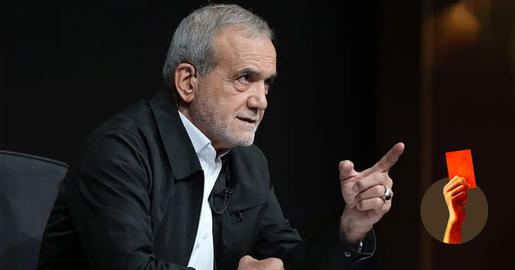
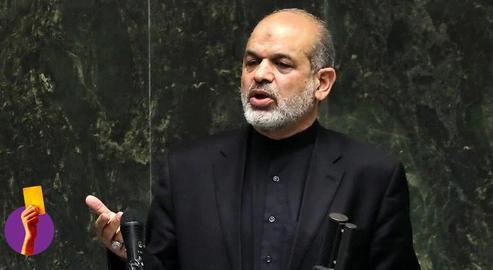
During a cabinet meeting on November 3, Masoud Pezeshkian stated, “Those who commit the most heinous anti-human acts then accuse us of being against human rights.”
He added, “They are the real violators of human rights. They have no shame—they cut off people’s water and bread to force them to bow to their demands. The free people of the world have never bowed and will never bow to oppression, bullying, and tyranny.”
Has the Islamic Republic ever bombed women, children, or hospitals? Has the Islamic Republic respected the rights of women and children in armed conflicts?
Women and Children: The Victims of Wars
According to United Nations reports, women and children typically account for about 70-80 per cent of the victims in wars and conflicts.
These figures underscore the extreme vulnerability of these groups during wartime, particularly when violence spreads to residential areas and civilian communities.
UNICEF has also repeatedly emphasized in its reports that women and children are among the most vulnerable groups in armed conflicts.
International monitoring groups report that women and children are the primary victims not only in wars but also in the repression of popular uprisings.
In the repression of popular uprisings, women and children are consistently among the primary victims as well. Therefore, any country involved in a war or conflict contributes to the killing, injuring, and displacement of women and children, and no government engaged in such wars is without blame.
Has Iran Been Involved in War in the Last Three Decades?
Aside from the eight-year war between Iran and Iraq, which, according to the United Nations, resulted in the deaths of 300,000 to 500,000 civilians, Iran has been involved in many regional wars and conflicts in recent decades.
The Islamic Republic supports groups such as Hezbollah and Hamas but has not directly participated in these conflicts, or its participation has been covert and limited.
However, after the Arab Spring and the spread of domestic protests in Syria, which escalated into a civil war, Iran directly intervened under the leadership of Qassem Soleimani and the Quds Force, joining the war with the slogan of “defending shrines.”
The Islamic Republic sent military advisors to Syria and supported Bashar al-Assad in suppressing opponents.
According to United Nations reports, this suppression led to the massacre of hundreds of thousands of civilians, including women and children.
The United Nations Human Rights Commission reported on June 28, 2022, that over 306,887 civilians were killed in Syria over the past decade, with casualties estimated between 281,443 and 337,971.
Between 2011 and 2021, about 13 million Syrians were forced to flee their homes, with more than six million refugees leaving the country, many of whom were women and girls.
The Syrian Observatory for Human Rights reported that at least 15,671 women and 25,857 children were killed in Syria. The report also stated that Iran and Russia were responsible for the deaths of at least 67,905 civilians in Syria.
In 2018, Human Rights Watch accused Iran of recruiting and using Afghan and Pakistani children in the Fatemiyoun and Zainabiyoun brigades, reporting that at least 14 Afghan children serving in the Fatemiyoun Brigade were killed in Syria.
Although the war in Ukraine is primarily between Russia and Ukraine, Iran has acted as an ally to Russia, providing drones to the Russian military, which have caused significant casualties among the Ukrainian population.
According to a report by Save the Children” based on official United Nations Human Rights Commission data, at least 2,184 Ukrainian children have been killed in the Russia-Ukraine war, with thousands more injured, homeless, or orphaned.
The campaign against arms sales also reported that approximately 377,000 Yemenis have died, directly or indirectly, in the Saudi-Yemeni conflict, which the Islamic Republic of Iran has actively supported.
The International Centre for Strategic Studies reported on Iran’s role in arming the Houthis in Yemen’s conflict with Saudi Arabia, stating that Iran supplied the Houthis with various weapons and technologies, including anti-tank guided missiles, sea mines, drones, 122mm Katyusha rockets, portable air defense systems, ballistic and cruise missiles, and military vehicles.
The Houthis have used Borkan-2H short-range missiles to target Riyadh and other areas in Saudi Arabia. A United Nations expert group described these missiles as a “lighter version” of Iran’s Qiam-1 missiles, with Iran providing key components for them.
Iranian-made parts were also integrated into Yemeni surface-to-air missiles SA-2 to create the Qaaher surface-to-surface missiles. With Iran’s support, the Houthis have developed modified versions of Iran’s Quds-1 and Quds-2 cruise missiles.
Iran’s missile attacks on Israel in April and October, although causing relatively few casualties, demonstrate that, without Israel’s air defense systems, many women and children in Israel could have been killed.
The Massacre of Women and Children During the ‘Woman, Life, Freedom’ Movement
The Islamic Republic has not only played a direct and indirect role in the massacre and displacement of hundreds of thousands of women and children in Syria and Yemen but has also directly harmed women and children during popular protests in Iran.
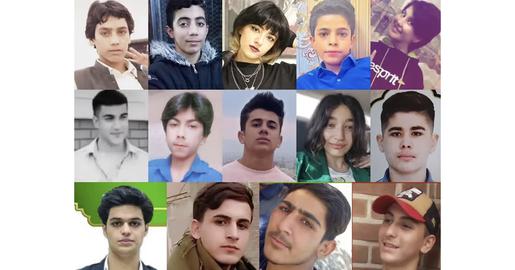
Center for Human Rights in Iran published a list in March 2023, following the Woman, Life, Freedom movement, naming 662 people killed in the protests, including 80 women and 68 children. This information indicates that the Islamic Republic has been responsible for the deaths of many women and children.
The recruitment and use of children by military and paramilitary forces is prohibited under several international conventions.
However, the Islamic Republic actively encourages children to join the Basij, a paramilitary organization linked to the IRGC.
Iran has even officially established a unit called the “Basij Student Corps,” tasked with recruiting and employing children in the armed forces.

Interested in writing for IranWire?
Share your stories.




comments