



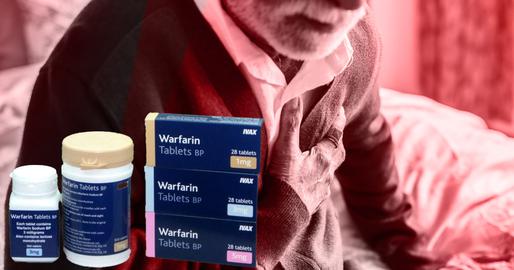


TEHRAN - In pharmacies of the Iranian capital, a quiet crisis unfolds.
Behnaz, a worried daughter, scans the shelves with a familiar sense of dread.
Her mother, three years post open-heart surgery, depends on a daily dose of Warfarin to keep life-threatening blood clots at bay. Yet, this vital medication has become elusive.
Until last year, she could obtain a limited amount of this drug for monthly consumption with a doctor's prescription at government pharmacies.
However, this year, the drug suddenly became very scarce, and even government pharmacies stopped distributing it.
They went through stressful days.
The end of each pack of pills was ominous, as the risk of blood clots constantly threatened her mother's life.
In the past two or three months, the situation has improved slightly. In some government pharmacies, Warfarin is now available to heart patients in limited quantities.
However, if a doctor prescribes 60 pills, the pharmacy will only dispense 20. Despite this improvement, Behnaz and her family still live in fear and stress over the constant supply of medication.
"The type and price of medicine is a story in itself. If the patient is allergic to the Iranian type of medicine and has to take foreign Warfarin, their problems are doubled," she says.
"They have to buy the drug at several times the price from brokers and middlemen, and sometimes they end up with expired medication."
Ramak, a cardiologist, discusses the importance of Warfarin for heart patients and those with valve problems.
"Patients with this condition or who have undergone open-heart surgery and are now facing blood coagulation issues must take one Warfarin tablet a day for life," Ramak says.
"So far, no alternative medication has been produced or prescribed worldwide.
"The shortage and difficult access to Warfarin in pharmacies has led to a high demand for expired foreign drugs, found in some pharmacies or on the black market.
"The use of expired drugs must be supervised by a doctor, and the patient's blood PT should be tested regularly to prevent coagulation."
The government price of Warfarin is 1,500 tomans, while the foreign type, if available, costs at least 25,000 tomans.
Original foreign Warfarin is usually imported from Turkey in small quantities, making it very difficult to access.
However, it may be found on the black market.
One broker offered a price, saying, "I have a foreign one with a record, 200,000 tomans each."
That means a pack of 28 pills costs five million and 600 thousand tomans ($100), an amount insufficient even for one month's supply.
The stocking situation of various medicines, from insulin to those for respiratory, kidney, gynaecological, and cardiovascular diseases, remains critical in the country.
Although the Warfarin situation has shifted from severe scarcity to limited availability, the risk and stress persist for heart patients and their families.
Government officials' false claims about the normalization of the situation and widespread distribution of Warfarin have raised concerns among some members of the Parliament.
For instance, MP Mohammad Jamalian said, "Despite government and Ministry of Health announcements that Warfarin was provided in sufficient quantities, people still struggle to obtain it.
This shows that special attention has not been paid, and we still face shortages of respiratory drugs and medications for incurable and special patients."
This reaction followed statements by Gholamhossein Sadeghian, Director General of Drugs and Substances under the Food and Drug Organization, who claimed: "During the last week, 13.7 million units of Warfarin were distributed in the country."
Considering the consumption rate of four million pills per month, there should not be any shortage.
However, visits to Tehran pharmacies tell a different story.
Mohammadreza, a pharmacist, explained the reason for the Warfarin shortage, "Until last year, this drug was imported from Canada, Sweden, and England.
"However, due to sanctions and currency provision problems, imports from these primary manufacturers have ceased.
"Now, imports are only from Finland, Lithuania, Spain, and Russia. Some pharmaceutical companies also import lower-quality raw materials from China and India for domestic production.
"However, challenges with foreign currency provision, rising dollar rates and lack of government support have minimized production."
Mehdi, another Warfarin user, said: "I used Warfarin produced in Lithuania, but it’s no longer available, so I had to buy Indian medicine.
"The quality is significantly different, and the drug's side effects are more than others.
"It seems the authorities do not understand the problems caused by changing the brand and type of medicine."
Despite doctors and pharmacists acknowledging the shortage and lack of a substitute drug, authorities deny the issue.

Interested in writing for IranWire?
Share your stories.




comments