



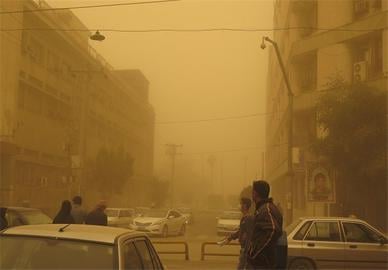
The sun never truly rose in Ahvaz on Tuesday.
Instead, the day turned into in a strange, eerie scene - a heavy cloud of dust casting everything in a dull brown.
The morning light barely pierced the thick haze, which was recorded at 67 times more polluted than what’s considered safe for human breathing.
“On Tuesday, everywhere looked like a scene from an apocalyptic movie,” says Hamid, his sentence punctuated by the violent coughs that have become the ambient soundtrack of Khuzestan.
The 40-year-old lifelong resident of Ahvaz apologizes for each painful cough. “We’ve seen many dusty days, but from last night until today, I’ve coughed so much that my liver burns.”
The statistics speak with cold clarity: residents of Khuzestan suffer from more than double the national average of asthma cases in Iran.
Local doctors have documented direct links between these dust particles and a deadly chain of conditions - lung cancer, heart attacks, Alzheimer’s disease, type 2 diabetes, and inflammatory illnesses.
Yet statistics fail to capture the lived reality of April 15, when an unprecedented dust storm swept through Khuzestan like a biblical plague.
The previous evening had been uneventful by Ahvaz standards. Hamid and his wife visited his brother’s home, planning a simple overnight stay. His wife had cleaned their own home before leaving.
“She had cleaned and polished everything,” Hamid recalls. “We were supposed to stay overnight and return on Tuesday.”
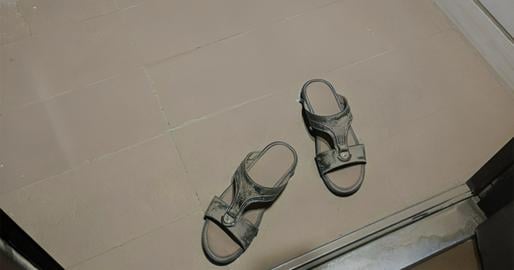
They came back to find their home violated. The dust had infiltrated every defence - double-glazed windows, tightly drawn curtains - accumulating in thick layers on furniture, seeping into cabinets, coating dishes and clothes.
But the truly unsettling discovery awaited them outside.
"When we got into the car in the evening, it was as if grease had been smeared over it instead of dust," Hamid says. "It was oily, sticky and really hard to clean.”
This wasn’t ordinary dust. It was laced with something far more dangerous: industrial waste, chemicals, and the accumulated damage of years of environmental neglect.
The catastrophe extended far beyond Ahvaz. Cities like Andimeshk, Mahshahr, Shush, and Abadan disappeared under the same choking shroud.
Even Isfahan and Bushehr, far from Khuzestan’s borders, reported crippling levels of dust.
In Abadan, one resident shared photos of his yard, which had been transformed into an alien landscape. "On top of this volume of dust with unknown pollutants, add the thick smoke from burning rubbish in some areas," he wrote.
“It reminds me of the days after Resolution 598 and the end of the Iran-Iraq War. Back then, too, whoever returned saw a city buried in dust, fire, and ash. A ruin that still hasn’t risen from the ashes.”
Decades after that devastating war, Abadan now faces a different battle - one against environmental catastrophe.
While officials were quick to blame desert winds from Iraq and Saudi Arabia, local activists tell a more complex story.
"Behind these crises, nature alone isn't to blame," says Reza, an environmental activist who has spent years documenting Khuzestan's slow-motion collapse. "It's a policy that has paved the way for disaster."
He points to the drying Hoor al-Azim wetland - once a natural barrier against dust storms, now reduced to a cracked, barren expanse.
“This is the result of drought, excessive water diversion, oil extraction projects, and years of top-down decisions from Tehran made without consulting local experts,” he says.
The wetland doesn't just lie dormant - it’s on fire.
Residents report that Hoor al-Azim has been burning for months, adding toxic smoke to the already unbearable dust.
"Oil contracts, unsound dam construction, and silence in the face of unauthorized withdrawals from water resources, under the pretext of national development," Reza lists off. "These are what have cut off Khuzestan's breath."
The crisis has spanned multiple administrations. As one local activist put it, “Different governments have come and gone, but the dust remains.”
President Masoud Pezeshkian’s newly formed administration is accused of repeating the same inaction that characterized its predecessors.
"At the beginning of its term, it did nothing special except repeat the promises of its predecessors," the activist says. "The budget for combating fine particles is still dripping."
Meanwhile, the industrial giants fueling the crisis continue to operate with minimal oversight.
"Oil companies continue to just install signs about 'social responsibility' without any filters for their pollution," the activist adds.
For many in Khuzestan, dust has become more than an environmental hazard - it’s a symbol of systemic neglect and exploitation.
“Dust in Khuzestan isn’t just suspended particles,” explains one resident.
"It’s a metaphor for chronic discrimination and inequality from a region whose wealth powers other provinces yet receives none of the basics in return. Not clean air. Not gas. Not water. Not electricity. Not schools. Just dust and the sound of wheezing lungs.”
The cruel irony isn’t lost on anyone: Khuzestan, a major producer of Iran’s oil wealth, receives little in return.
“If they keep sacrificing Khuzestan’s lungs in the name of energy security and national development,” says an Ahvaz local, “this suffocated land will not only kill its people - it will also bury public trust.”
The aftermath of Tuesday’s storm overwhelmed local infrastructure. Hospitals reported over a thousand cases of respiratory distress. Flights were canceled. Streets emptied as the city gasped for air.
Social media is filled with apocalyptic images - dust-choked streets, visibility reduced to mere feet, and masks rendered useless by microscopic invaders.
In one particularly haunting video, a woman tries cleaning her balcony, only to see more dust settle as she sweeps.
“How do you fight something that never stops coming?” she asks.
As night fell once again over Khuzestan, the dust lingered - a reminder that solutions remain as distant as clean air.
In the gathering darkness of Ahvaz, as another day ends without relief, one fundamental question remains unanswered: In a land where dust has become as permanent as the oil beneath it, who will finally prioritize the simple human right to breathe clean air?
The dust waits for no answer. It simply continues to fall.

Interested in writing for IranWire?
Share your stories.




comments