



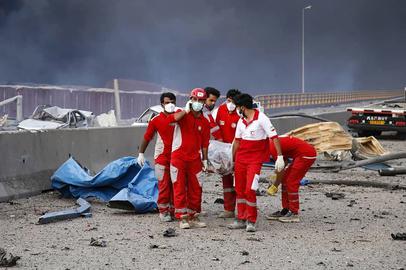

The Dammam drums echo through the streets of southern Iran as citizens mourn the victims of the port explosion in Bandar Abbas.
While officials report 70 people dead and over 1,200 injured, residents believe the actual numbers are much higher.
As the government faces criticism for its response, ordinary Iranians have mobilized to support victims and their families.
From free psychological counseling to transportation assistance, these grassroots efforts have become what one resident calls “an ointment on the festering wound of the people of Bandar Abbas.”
“My days in this world are not over; otherwise, I would have been gone like my friends today,” says Mostafa, who works at Shahid Rajaee Customs.
He had taken the day off to pick up his in-laws when the explosion occurred, killing three of his colleagues.
The governor of Khuzestan acknowledges 22 missing persons and unidentifiable bodies, but conversations across the city suggest that more remain unaccounted for.
As darkness fell on that first terrible day, pictures began circulating on social networks - faces of men and women who had gone to work at the customs office and port, as usual, that morning but never returned home.
Photos initially shared with captions like “missing...” gradually shifted to “killed” or “injured” as the grim reality set in.
But amid the devastation, something remarkable has emerged: a nationwide wave of compassion.
“How long will your services be free?” asked one desperate resident in a message to the Raz Mehr Psychological Counseling Center.
“Until peace is restored,” came the simple reply.
This exchange, captured in a widely shared screenshot, exemplifies the spontaneous movement of solidarity that has swept across Iran in response to the disaster.
While officials continue to face scrutiny for their handling of the crisis, ordinary citizens have stepped in to fill the void.
In the aftermath of the explosion, psychologists, doctors, and nurses across the country took to social media to offer their services.
From private practices to major hospitals, medical professionals pledged free emergency care for blast victims, understanding that professional duty transcends financial concerns in catastrophic moments.
The Arma Mental Health Center issued a public statement via Instagram: “Honorable people of Iran, if you need emergency psychological and psychiatric help following the heartbreaking incident in Bandar Abbas, we are
here.”
For a population grappling with severe trauma, these offers represent more than medical assistance - they acknowledge the profound psychological toll of the disaster.
Recognizing that grief knows no borders, the group Diyaar Family organized free online workshops designed specifically for Iranians living abroad with loved ones in Bandar Abbas.
However, not all help has come from professionals. Across Iran, everyday citizens have found creative ways to extend support.
The Tapsi taxi company, though not operating in Bandar Abbas itself, published discount codes on social media, allowing victims' families to use Snap, Iran’s version of Uber, free-of-charge taxis for hospital visits and funeral arrangements.
A coalition of car mechanics offered to repair damaged vehicles at no cost to residents affected by the blast.
In Shiraz, where officials claimed only 12 patients were transferred for treatment, hospital workers shared a different reality.
“So many injured have been brought to our hospital that there’s no room; many are being kept in the hallways,” revealed one medical staff member, speaking to IranWire.
Citizens of Shiraz opened their homes to the families of the injured, volunteering to house those with nowhere to stay and even sitting with patients who had no one to accompany them during treatment.
Mostafa, still grappling with his narrow escape, has taken in the children of a colleague who died in the explosion. They had attended school with Mostafa's sons.
“Life has been poisoned for us these past three days,” he says. “I brought the children to our house. My mother-in-law is taking care of them. My wife and I go to my colleague’s house to see if we can help his grieving wife".
When asked why he took on this responsibility amid his own trauma, Mostafa replied, “I thought to myself that maybe just being by his wife’s side could help. I don’t know; at least I have a car. If there’s any commuting needed for ceremony arrangements, they won’t have to pay.”
He pauses, then adds, “I know her family and relatives are there. I’m just doing my part to serve.”
Social media has become a vital resource for desperate families. Speaking in the local dialect, one individual described using their sizable online platform to help locate the missing.
“I posted a story and asked people to send me names and photos if they were looking for someone so I could share the information,” they explained. “If this page and platform aren’t useful today, when will they be?”
The digital volunteer acknowledged the risks of such public efforts in Iran’s restrictive media environment.
“I know they might come after me. I’m not brave enough to say I don’t care, but I haven’t done anything wrong. I’ve done what I could to help my compatriots. How is that a crime?”
Outside Shiraz University, citizens gathered with lit candles as a woman sang sharveh, a traditional southern Iranian lament for the dead.
Similar scenes have unfolded across southern cities from Bushehr and Kangan to Abadan and Ahvaz, where the ancient rhythms of mourning, with cymbals and Dammam drums, fill the streets.
The Dammam has always been the people's instrument, warning of danger and calling communities together in times of crisis.

Interested in writing for IranWire?
Share your stories.


comments