



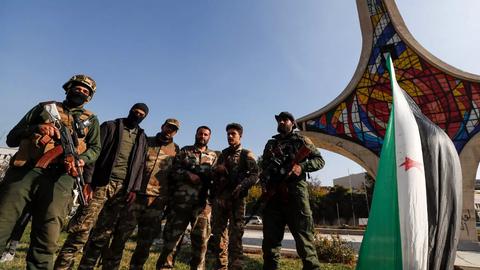
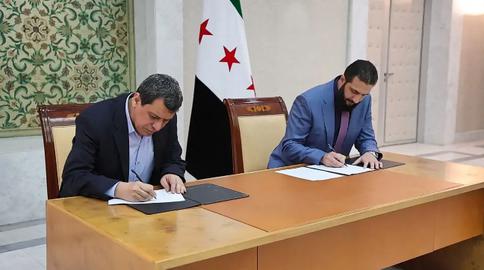
A landmark agreement between Syria’s interim government and the Kurdish-led Syrian Democratic Forces (SDF) has triggered widespread reactions, potentially reshaping the Middle East’s geopolitical order.
Ahmad al-Sharaa and Mazloum Abdi signed an eight-point agreement this week, scheduled for implementation by the end of this year.
Under the accord, all civil and military institutions in northeastern Syria will integrate with the central government, which will oversee airports, oil and gas fields, and border crossings.
The agreement also establishes a ceasefire across Syrian territory and addresses the return of hundreds of thousands of Syrian refugees to their homes with security guarantees.
The second article of the agreement states: “Recognition of the Kurdish community as an authentic and indigenous community in Syria, with full guarantee of citizenship rights and all rights enshrined in the constitution.”
The agreement follows shortly after Abdullah Öcalan, leader of the Kurdistan Workers’ Party (PKK), called for his organization to lay down arms and dissolve, inviting his supporters to convene a congress to decide on his proposals.
Many political analysts and experts believe the agreement signals an emerging new order in the Middle East.
The developments, including geopolitical agreements, shifting alliances, and the increasing role of regional and global powers, have been extensively analyzed by experts and politicians, including Iranians.
Farhad Shami, SDF spokesperson, clarified that there are no changes regarding files related to ISIS prisoners, which remain under SDF control.
He described the agreement as an important and fundamental step and denied reports of Damascus forces being deployed to the Hasakah region.
Ammar Goli, a Middle East analyst, wrote on X that based on the published text, SDF forces and governmental institutions will integrate with the central government, and Damascus will work in oil and gas fields.
In effect, the central government has implicitly recognized the autonomous administration of northern and eastern Syria, known as Rojava.
Additionally, several senior SDF commanders will be sent to Damascus to participate in Defense Ministry management, with one possibly becoming Deputy Defense Minister.
Behnam Zarei, a Middle East and Kurdistan expert, assessed the agreement as a step toward a decentralized and pluralistic Syria, though ambiguities remain.
He views the agreement as “a transformation in Syria’s structure” that could spread to other parts of the country.
“This agreement strengthens dialogue and cooperation and expands implementation mechanisms that could reduce internal tensions and stop foreign attacks, especially from Turkey. These developments will be positive for Kurds, at least in the short term.”
Salahuddin Khadiv, another Middle East analyst, took a different stance.
He believes that in Bashar al-Assad’s former palace, two young leaders - Kurdish and Arab - are dividing power.
“These two represent two opposing universalist discourses. When American tanks roamed Baghdad’s streets, crushing the Sykes-Picot Middle East under their wheels, Farhad and Ahmad were idealistic young men with passionate imaginations about the region’s liberation.”
The Kurdistan National Congress (KNK) also welcomed the recent agreement in a statement, describing it as an important step toward “achieving a political solution to the Syrian crisis.”
According to the KNK statement, the agreement includes eight key points, with the United States, Britain, France, and Germany playing roles in the negotiation process.
The agreement between Mazloum Abdi and Ahmad al-Sharaa, whether for greater power or for the collective interests of their supporters, marks a turning point in redefining the balance of power in Syria.
Many believe this agreement not only indicates a transition from exhausting conflicts to strategic cooperation but could also be the beginning of a new regional order.
Islamic Republic’s Reaction
Tasnim News Agency, affiliated with the Islamic Revolutionary Guard Corps (IRGC), published a report on March 11 discussing Mazloum Abdi’s reaction and, favoring Turkey’s position, labeled him a “terrorist.”
“Over nearly more than a decade of war and crisis in Syria, Mazloum Abdi, with US and Western support, managed to capture and occupy northern and northeastern Syria under the pretext of confronting ISIS elements.
“Previously known by his organizational name ‘Shahin Jilo’ in the terrorist PKK group, he has always been at risk of elimination and assassination by Turkey. Turkey considers him and his subordinates to be the Syrian branch of the PKK and terrorists.”
The Tasnim report added that unlike Öcalan, who called for the disarmament and dissolution of the PKK, Abdi, while signing the agreement with al-Sharaa, declared that it does not include Kurdish militants under his command.
Fars News Agency, also affiliated with the IRGC, published news of the agreement while highlighting its impact on Turkey.
“Areas under SDF control are of great importance in Syria due to their economic wealth. Most of Syria’s oil and gas wells, as well as water dams built on the Euphrates River, are located in this region.
“Additionally, this area is known for agriculture due to its fertile soil; hence, it is referred to as Syria’s ‘food basket.’ This makes the agreement between al-Sharaa and the SDF a historic one that will have many impacts both inside and outside Syria.”
The Fars report also emphasized the importance of the SDF being under American influence.
“Now Kurds not only see their dream of establishing a Syrian Kurdistan (Rojava) vanish but also face much worse conditions under al-Sharaa’s government.
“Al-Sharaa’s opposition to the continuation of Kurdish semi-autonomy in northern and northeastern Syria, along with his close relations with Turkey and Turkey’s longstanding enmity with Kurds, makes conditions increasingly difficult for them.”
It appears that rather than Turkey being affected by this agreement, as portrayed by Islamic Republic-controlled media, it is the IRGC and the Islamic Republic that are dissatisfied.
Interested in writing for IranWire?
Share your stories.


comments