



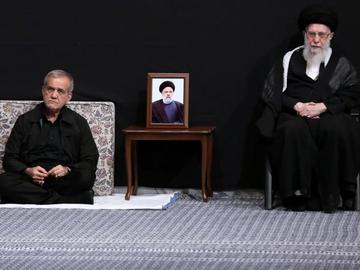
The words were barely out of President Masoud Pezeshkian's mouth before the backlash began.
In a one press conference, Iran’s president upended months of diplomacy, igniting a political crisis that exposed divisions within the Islamic Republic’s leadership.
"If we don't talk, what should we do? Do you want to fight?" Pezeshkian asked. "Well, they hit us, we rebuild, and they'll hit us again."
What followed was a political earthquake. Officials from the Islamic Revolutionary Guard Corps (IRGC) questioned his judgment. Conservative newspapers accused him of projecting weakness. Social media is filled with calls for impeachment.
The dispute shows how fragile Pezeshkian’s position has become just a year into his presidency, with hardliners increasingly viewing his foreign policy as naïve and damaging to Iran’s interests.
The harshest criticism came from within Iran's own security establishment. Aziz Ghazanfari, Deputy Political Chief of the IRGC, warned that repeated verbal errors could compromise national security.
"The foreign policy field is not a place to express every reality," Ghazanfari wrote on the IRGC-affiliated Bassirat website. "The dangers of incorrect statements by high-ranking government officials primarily affect the governments themselves."
Ghazanfari reminded readers that Pezeshkian had relied on prepared texts during his presidential campaign to avoid mistakes, suggesting he return to that practice.
The criticism carried an implicit threat - the IRGC, Iran's most powerful military force, was publicly questioning the president's competence.
Ali Fadavi, deputy commander-in-chief of the IRGC, delivered what many interpreted as a direct rebuke the day after Pezeshkian's remarks.
"Armed forces have not been and are not on holiday," Fadavi said. "The fight between right and wrong has existed from the beginning and will continue to the end."
He warned that another Israeli attack could happen if "the enemy feels successful," while also claiming that “recent defeats” had forced Israel to request an end to hostilities - a subtle contradiction to Pezeshkian's more conciliatory tone.
Conservative media outlets launched coordinated attacks on the president's foreign policy approach.
Tasnim News Agency, affiliated with the IRGC, ran headlines warning, "Words are not neutral, Mr. Pezeshkian, be careful."
The agency accused Pezeshkian of projecting "a weak and helpless image" and suggesting Iran "has no choice but negotiation" - an interpretation that could undermine even the negotiation process by signaling desperation.
Keyhan newspaper, edited by an appointee of Supreme Leader Ali Khamenei, delivered perhaps the most scathing critique.
Editor Hossein Shariatmadari accused Pezeshkian of falling for a false “negotiation or war” choice and effectively yielding to U.S. pressure.
"America, after defeat in war, seeks to deceive through negotiation, and the president, with such positions, inadvertently reinforces this deception," Shariatmadari wrote, urging Pezeshkian to choose advisors who could prevent such “diplomatic missteps.”
Hardline lawmakers, already pursuing impeachment proceedings, seized on the statement as evidence of Pezeshkian's unfitness for office.
MP Hamid Rasaei called the statements proof of "an unstable and shaky personality" that “conveys weakness to enemies.”
"His speech completely contained messages of weakness and threat," wrote one social media user. "How unlucky we are that we even have to worry about the president speaking."
The criticism extended beyond traditional hardliners. Hesamodin Ashna, a former advisor to Hassan Rouhani, explicitly urged Pezeshkian to "stop being clever and improvising."
He said the country’s “second-ranking official should speak with precision or not speak publicly at all.”
The controversy followed a pattern of statements critics consider diplomatically damaging.
Pezeshkian's dismissal of the Zangezur corridor dispute as a "minor issue" particularly infuriated security officials who view the proposed Armenia-Azerbaijan transit route as a potential NATO “infiltration pathway.”
"There's no need to worry about some minor issues, including the northwestern corridors of the country," Pezeshkian had said, prompting Keyhan to accuse him of “minimizing a threat to national security.”
The corridor, which would connect Azerbaijan with its Nakhchivan exclave through Armenian territory, has sparked Iranian concerns about Western military access to its northern borders.
Officials warn that American involvement in the project could be an attempt to encircle Iran geopolitically.
Parliamentary National Security Commission member Fada Hossein Maleki, without naming Pezeshkian, said that while Iran supports peaceful dispute resolution, American participation "has no legitimacy in international custom" and poses a threat to regional stability.
Pezeshkian's troubles partly stem from his admitted inexperience in international affairs. Before his first foreign trip to Iraq, he openly said, "I don't know diplomacy.”
His verbal gaffes have become notorious among critics. He has repeatedly referred to the "Soviet Union" instead of Russia, described Egypt as a "friend and brother country" despite long-standing tensions, and most seriously, revealed details about Iran's hypersonic missile capabilities during an Al Jazeera television interview, information security officials preferred to keep classified.
Critics say these errors reflect a deeper unpreparedness for the complexities of international relations.
Pezeshkian's appearance on former Fox News host Tucker Carlson's show triggered another wave of criticism.
Conservative newspapers attacked his comments about the "Death to America" slogan and his denial of any intent to assassinate U.S. President Donald Trump.
The interview was especially controversial as it took place during the 12-day war in June, when hardliners expected stronger messaging against U.S. support for Israel.
Instead, Pezeshkian appeared to draw a distinction between the U.S. and Israel, suggesting the possibility of dialogue with Washington.
Mohammad Javad Larijani, an international affairs analyst, warned against "whitewashing America's role in recent aggression against Iran," saying the president’s attempt “to separate American and Israeli policies conveyed dangerous weakness.”
"America has complete leadership of the war and regional seditions against the Islamic Republic of Iran," Larijani said, adding that Pezeshkian's conciliatory approach had “encouraged American officials to make new demands.”
Online criticism has evolved into organized campaigns calling for Pezeshkian's removal.
The hashtag "Remove Pezeshkian" regularly trends on Iranian social media, with critics accusing him of endangering national security.
"Masoud Pezeshkian, with his ignorance and political immaturity, has crossed red lines that even ten presidential terms might not have the power to restore," one user wrote, expressing hope that Western officials would “ignore Pezeshkian and focus on Supreme Leader’s statements instead.”
Another user accused him of committing acts "against national security and territorial integrity.”

Interested in writing for IranWire?
Share your stories.



comments