



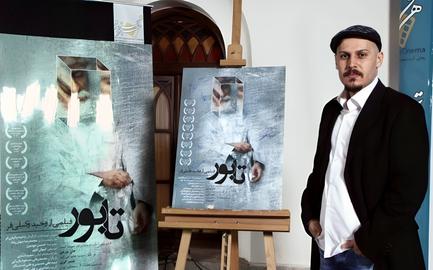
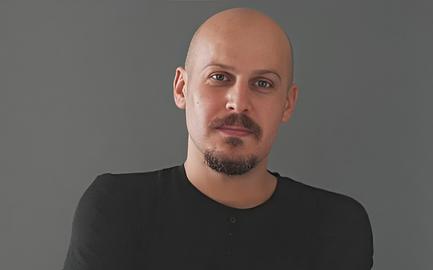
Driven by financial despair, an Iranian filmmaker has decided to sell one of his kidneys to survive.
Vahid Vakilifar, a 43-year-old independent filmmaker, has earned acclaim for his poignant and visually striking works that have captivated audiences worldwide. Yet, the harsh realities of life in Iran have left Vakilifar financially crippled and desperate.
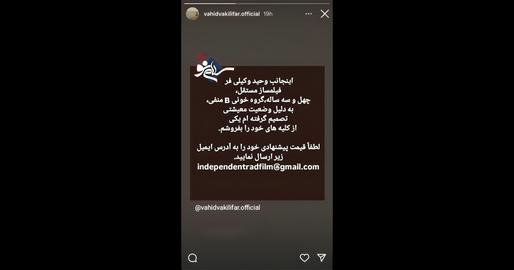
In a recent Instagram post, Vakilifar revealed his decision, saying, “I, Vahid Vakilifar, 43 years old, blood type B negative, have decided to sell one of my kidneys due to my financial situation.”
His desperate choice highlights the precarious reality many Iranian artists face, who are forced to make unthinkable sacrifices to keep their artistic vision alive.
Vahid Vakilifar's debut film, Geshar, made waves in the international film circuit, earning recognition from prestigious festivals and publications.
The Hollywood Reporter hailed his work, saying, "Though perhaps a touch too oblique for its own good, Gesher represents a quietly promising feature debut from Iran’s 29-year-old writer-director Vahid Vakilifar."
Yet despite his talent, Vakilifar remains one of Iran’s underappreciated cinematic voices.
Of his four distinct works, two were screened in a limited release through the Art and Experience cinema initiative, but his last two films never gained approval for public screenings in Iran.
The independent filmmaker’s K9 could arguably be recognized as the first science fiction film in Iranian cinema's history.
Vakilifar’s desperation to make ends meet raises a larger question about independent artists in Iran: why do they often end up abandoned and isolated, unable to claim their rightful place in the public sphere?
From Uncle Hatam to Adnan Afravian: Forgotten Talents in Iranian Cinema
Vakilifar’s struggle isn’t unique. The industry largely forgot Hatam Moshmoli, known as Uncle Hatam, who died on August 26 from kidney failure.
A charismatic man with a powerful voice, he first captivated cinemagoers in Hamid Nematollah’s acclaimed 2004 film Boutique. Despite his enigmatic presence, Boutique remained Moshmoli's only appearance on the big screen, and he disappeared from cinema for over 15 years.
He lived in a cafe in southern Tehran, doing odd jobs for shopkeepers and market vendors until he resurfaced on the TV show Ketab-Baz. During the program, he avoided explaining his absence from cinema, simply stating that he valued enjoying life more than seeking social status.
Some might assume that recent hardships—especially the impact of the COVID-19 pandemic, a worsening economic crisis, and a growing divide between artists and the government—have intensified these struggles.
However, this is not the whole story.
Other former cinema talents, like Adnan Afravian, have also briefly risen to fame and, ultimately, faded into obscurity.
In 1986, he portrayed a war-torn child from Khuzestan in the classic film Bashu, the Little Stranger. His performance, along with his chemistry with Sosan Taslimi, left a lasting impression.
Yet for years, Afravian has worked in a kiosk selling cigarettes and phone credits, with no opportunity to develop his cinematic career further. In interviews, he shared that after filming ended, he was left on his own. As a young talent, no one guided him on how to stay in the cinema world.
Artists' Desperation and the Silence of Agencies
Arash, a playwright and theater director, expressed sorrow over Vahid Vakilifar's grim situation.
He told IranWire: “Independent artists have always been abandoned by their guilds, associations, and organizations when they are in critical need of support.
“To give an example, not long ago, news surfaced about the illness of Reza Ashofteh, a theater critic."
“None of the associations offered any help. In the end, fellow theater professionals had to raise money to support Reza’s treatment. This is the reality for someone who was a member of the Theater Critics Association, while independents don't even receive this minimal support.”
According to this director, among those working in independent theater, only a few fortunate individuals from wealthy families can continue their work. "The rest gradually fall out of the field," he said.
"If you visit advertising agencies, you'll find many theater professionals who, due to lack of money, have turned to advertising jobs just to continue funding their theater projects."
"But this only works for a year. After that, the body and mind are so exhausted that all you want to do is rest to be able to work again the next day. Slowly, the art you once loved fades into the background."
Arash pointed out that many talented, independent people in Iranian art face similar struggles for livelihood and have been abandoned.
"In theater, we had the great Saadi Afshar. His home, when you see it, would make you cry. He became addicted, and no guild ever came to his aid. The government certainly didn’t either. Financial support for independent artists does not seem to be a priority for any guild or group."
The independent director and playwright also emphasized the lack of opportunities for independent artists, saying, "The Ministry of Culture and Islamic Guidance, the Cinema Organization, the Art Bureau, Television, streaming platforms, and theater halls offer no platform or opportunity for independent artists in theater or cinema."
"On the other hand, guilds are groups of veterans who often look down on younger and different voices."
Voices of Frustration and Protest
Another independent theater director in Iran, Reza (a pseudonym), told IranWire, "All my colleagues in Iran, whether on stage or in street theater, are struggling with severe financial and livelihood issues. Some of them face concerns far more pressing than those of ordinary people."
Reza explained that theater artists have repeatedly protested for better livelihoods and professional support but have never received a meaningful response.
"In the 2022 protests, more than 100 artists from the stage, film, theater, and music were arrested. Some are still banned from working and appearing on screen, with legal cases filed against them."
"Two years before the Woman, Life, Freedom movement, a group of theater artists wrote a statement and protested in front of Parliament for their livelihood demands. Nothing changed."
He added, "We don’t have a fixed or guaranteed income from theater. We receive wages based on our activity. When there’s no work, what can we do but take unrelated jobs or resort to desperate measures, like selling a kidney?"
Reza sees Vakilifar’s act as a wake-up call - an alert for responsible authorities and professional bodies in various artistic fields.
"Our professional organizations have unfortunately become places for those directly or indirectly connected to the government. The closer their connection to the government, the larger their share of the culture and arts budget," he said.
Interested in writing for IranWire?
Share your stories.


comments