



By Haleh Boroujerdi
“When I sit behind the telescope and gaze at the stars, the magnificence of creation and the universe dazzles my eyes and my heart.”
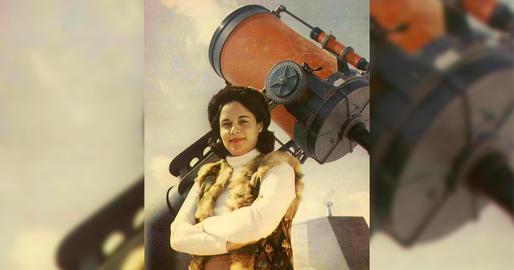
This is how Shahla Solhju described her emotional connection to her profession in an interview with the weekly Zan-e Rooz (“Woman of Today”) on December 3, 1977. Alongside Alenush Terian, Solhju shattered barriers in a male-dominated field, earning recognition as one of Iran’s pioneering female astronomers.
A Star Among Astronomers
Shahla Solhju rose to public prominence in 1976 when Empress Farah, the last queen of Iran, inaugurated the country’s first modern research observatory in Shiraz. Named after the 11th-century Iranian polymath Abu Rayhan Biruni, the facility was part of Pahlavi University (now Shiraz University).
During the event, it was announced that Solhju, a distinguished graduate in astronomy, had been appointed as the deputy director of the Biruni Observatory. At the time, she was pregnant with her second child.
Soon after, a Zan-e Rooz reporter visited the observatory and described Solhju as “the only woman who pampers the stars at night. She does not sleep so she can sing lullabies to the stars.”
The reporter wrote: “Ms. Shahla Solhju had indeed chosen an unusual profession. Astronomers work mostly at night when the stars are visible. This, of course, makes us wonder why a young mother of two—a nine-year-old and a six-month-old—chose such a career. But Ms. Shahla is not just a mother of two earthly stars, Afshin and Ramin; all the stars and planets in the sky are her children as well. She has two on Earth and millions of celestial ones: Mars, Jupiter, Saturn, Uranus, Venus, Neptune…”
Breaking Gender Barriers
“Shahla belongs to a generation of women in Iran and around the world who are raiding the last exclusively male citadels,” noted the reporter. “They are emerging victorious and demolishing the myth of gender-dependent professions.”
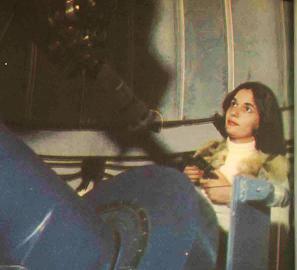
In a notable achievement, Solhju collaborated with renowned American astronomer Dr. Edward Guinan to study binary stars at the Biruni Observatory. Over four consecutive nights, she conducted three-hour observation sessions to measure the brightness of two stars orbiting each other.
Two Keys to Two Worlds
“She always carries two keys in her pocket,” wrote the reporter. “One is to her family home in a charming alley near Eram Garden in Shiraz, where she lives a happy life surrounded by pomegranate, persimmon, and orange trees. The other is to the observatory, to which only three people besides her have access.”
On clear nights, Solhju would climb the narrow stairs of the observatory, unlock its doors, and immerse herself in stargazing through the facility’s 14-inch telescope. “She surveys the galaxies inch by inch with her inquisitive eyes and holds friendly conversations with the stars,” the article read.
The observatory’s rooftop telescope, located at the highest point in Shiraz, was her pride and joy. “After using the 14-inch telescope, Ms. Astronomer swaddles it like a baby to protect it from rain.”
Solhju noted that Shiraz’s 260 to 280 clear nights per year made it an ideal location for astronomers. She lamented the occasional cloud cover, saying, “Clouds are the enemies of astronomers. These moving clouds that constantly roam the sky like dilapidated quilts give us a nervous breakdown.”
A Life Shaped by Curiosity
Solhju credited her upbringing for shaping her love of learning. “My father, an avid reader, nurtured a love for books in his four daughters. He chose to buy us books instead of dolls,” she recalled.
After completing high school, Solhju went to Manchester to continue her studies but returned to Shiraz after a year due to homesickness. She completed her education at Pahlavi University, receiving a scholarship for her academic excellence. She married a PhD student from Tehran while still in graduate school.
Life after marriage was challenging, she admitted: “I studied, worked, and took care of the children and household responsibilities.”
Academic and Professional Achievements
Solhju became the first woman to teach physics at the university level in Shiraz, later expanding her expertise to teaching astronomy. Her career took her to Scotland, where she and her husband pursued further studies at the University of St. Andrews.
“In Scotland, I worked at the observatory at night and devoted my days to studying,” she recounted. “However, Scotland posed challenges for astronomers. The skies were rarely clear. We spent many nights pulling back curtains, hoping for a glimpse of a star. This made me appreciate Shiraz’s clear skies even more.”
Women and the Stars
Solhju believed that women were well-suited to astronomy. “Astronomy is an intricate science that requires a great deal of patience, which is why there are more women in this field compared to other scientific disciplines,” she explained.
At the University of St. Andrews, 50% of astronomy students were women. Solhju highlighted the contributions of Annie Jump Cannon, a renowned astronomer who classified nearly 22,500 stars.
However, she acknowledged the unique challenges women faced: “Had I been a man, I wouldn’t have had any issues going to the observatory alone. But as a woman, it’s difficult to come to this remote mountaintop location at midnight by myself. That’s why couples who work together in this field tend to succeed more.”

Interested in writing for IranWire?
Share your stories.


comments