



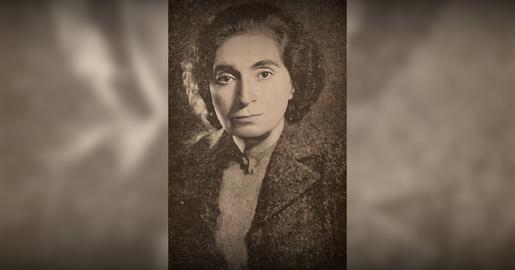
By Mona Barati, Citizen Journalist
“Ever since my childhood, I have had a great love and passion for social services and progress in the world of women. I have always thought about the institution of family and the nurturing of a mature and productive generation. I have always thought that something should be done to enlighten the minds of women and families. Therefore, I worked to form a society of progressive women called the Patriotic Women's Society, and I have been an active member of the board of directors of that society since its inception."
These words introduce Noor-ol-Hoda Mangeneh’s memoirs and her significant role in the Iranian women’s movement. Despite being less recognized compared to her contemporaries in the Patriotic Women's Society and other early 20th-century women’s rights groups in Iran, Mangeneh’s contributions remain crucial.
Noor-ol-Hoda Mangeneh was born in 1902 into an intellectual family closely associated with the Qajar royal court. Her father, Mirza Ali Moshir Daftar, served as a court secretary, and her mother, Rokhsareh Mehr-ol-Dowleh, was an educated and progressive woman of her era.
“My family valued knowledge and arts, and my parents were enlightened individuals. They made no distinction between boys and girls in terms of education. My siblings and I began our education with skilled teachers at the age of four or five,” Mangeneh recounts in her memoirs, A Glimpse Into My Life, one of the most important accounts of the women’s movement in Iran.
He was also an amateur photographer and a proponent of modern education. Mangeneh’s father was fluent in French, English, and Arabic as he ensured his children were taught by Western and foreign tutors. Noor-ol-Hoda herself learned to play the piano as a child and the Iranian string instrument, tar. She wore clothes tailored by Western designers.
At a time when girls were often confined to their homes and boys were prioritized, Mangeneh enjoyed unique freedoms. Her father even took her out for public entertainment: “I remember well, it was winter, and I was four or five years old. A circus troupe from an unknown country had come to Tehran. My father wanted to attend and took me and my brother along. My hair was hidden under a hat, and I wore a boy’s overcoat so no one would recognize that a girl was among the spectators.”
Despite her progressive upbringing, Noor-ol-Hoda’s life took a turn when she was married off to a 50-year-old man at the age of 15. “Suddenly, I noticed everyone talking about my wedding, and our home was filled with cheer and rejoicing,” she wrote. “All this celebration and chatter neither pleased nor worried me. I viewed everything with indifference.”
She remained unaware that the full-length mirror, diamond ring, and long white silk gown were meant for her until the wedding day itself. She had no understanding of what was to come until she was married.
The groom, Gholam Hossein Khan, known as Moaven al-Molk Naraghi, was the Deputy Minister of Post and Telegraph and a wealthy man. However, he was old, already married with four children and a son-in-law. According to Noor-ol-Hoda, his hands trembled so much he could not even hold a cup of tea. Worse, he was addicted to opium and alcohol. Her parents discovered these issues too late; the marriage had already occurred, leaving them powerless to intervene. On their wedding night, Noor-ol-Hoda resisted the consummation of their marriage, setting the tone for the years to come.
Noor-ol-Hoda, a prudent young woman, treated everyone with kindness to avoid hostility. However, she felt the need to secure her own future. She began selling her dowry items, including the full-length mirror and pearl-studded sofas. With this money, she purchased her father’s garden on Iran Avenue, later selling it to buy land and a spacious 2,000-meter property with a garden, multiple rooms, a bathhouse, and a large greenhouse on Shahpour Avenue. This house would eventually serve as a meeting place for members of the Patriotic Women's Society.
A Movement was Born
After five childless years, her marriage ended in divorce. Following the separation, she joined the women’s movement and, at the invitation of Mohtaram Eskandari, became a founding member of the Patriotic Women's Society, one of the most progressive women’s organizations of its time.
“The Patriotic Women's Society was formed by progressive women in 1922,” she wrote in her memoirs. “We were a group of women committed to securing freedom, progress, and education for women. In general, we were determined to improve their lives. Its board of directors consisted of 10 women elected by the esteemed members of the society. They elected Ms. Eskandari as the chairman of the society and me as its first secretary.”
As the first secretary, one of Noor-ol-Hoda’s primary tasks was publishing the society’s newspaper. She also organized classes to educate women who had been denied schooling and enlighten them about their rights.
Although the founding members of the Patriotic Women's Society were from affluent backgrounds, they struggled to fund their activities. Noor-ol-Hoda proposed staging a play to raise funds from the female audience. At the time, women were not allowed to attend theaters, so she suggested disguising the performance as a wedding celebration. She personally wrote 300 invitation cards and enlisted Varto Terian, Iran’s first theater actress, to stage a play titled ‘Adam and Eve’. The play was performed on May 2, 1924, at Noor-ol-Hoda’s home.
The event, attended exclusively by women, faced backlash. Before the first act concluded, police raided the venue and dispersed the audience, allegedly incited by preachers claiming the gathering aimed to promote removing the hijab.
Despite the arrests and damage to her home, Noor-ol-Hoda remained undeterred. She was forced to rent another accommodation but faced continuous harassment. A few years later, the same play was staged again, this time with Varto Terian performing under the stage name “Lala” to protect her family from harassment. The society also rented a house on Vestahol Alley in Tehran’s Amirieh Avenue and transformed it into a women-only movie house.
The Patriotic Women's Society took bold measures to advocate for women’s rights. One notable act was burning copies of a pamphlet titled The Wickedness of Women in Toopkhaneh Square, Tehran’s main square. This pamphlet, written by opponents of women’s education and freedom, symbolized the resistance against progress.
After 1925, Noor-ol-Hoda went to Beirut to continue her education and studied child psychology at the American University of Beirut. Returning to Iran, she once again joined the activities of the Patriotic Women's Society. While she was away, Mohtaram Eskandari had passed away, and Mastoureh Afshar, another founder of the league, became the chairman of the society. At this time, the society focused on empowering women through education while continuing to fight against discriminatory laws.
For example, under the law, if a barouche passenger was a woman, the collapsible hood had to be unfolded to conceal her from view. This was just one among many such restrictions which exemplified the challenges faced by women in public spaces.
Providing women with education remained a cornerstone of the society’s mission, and Noor-ol-Hoda played a significant role in these efforts. She was one of the organizers of the Oriental Women's Congress, held in Tehran in late 1932.
Noor-ol-Hoda also launched her own magazine, Bibi, where she wrote extensively on women’s rights, education, child-rearing, family, and related subjects. In addition to her articles, she authored five books, including her memoirs, A Glimpse Into My Life.
Upon returning from Beirut, Noor-ol-Hoda taught at girls’ schools. Her fifth book was a collection of her poetry, published later in life. Her poems, reflecting varied worldviews and styles, include verses like:
Hard to be naked and sick
Hard to be hungry under a heavy load
With your trembling eyes and your wounded feet
Hard to run on thorns and barbs
According to reports, Noor-ol-Hoda Mangeneh passed away in 1986. However, reliable information about the date of her death and her final years is scarce. Regardless, her name endures as a pioneer of women’s rights in Iran, a legacy that continues to inspire future generations.

Interested in writing for IranWire?
Share your stories.


comments