



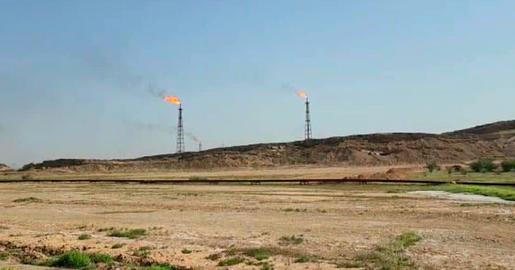
In the shadows of towering flames piercing the night sky, the people of Khuzestan province have learned to live with an invisible enemy.
Each breath they take serves as a reminder of the province's dark paradox: sitting on some of the world's richest oil reserves while plagued by some of the most polluted air.
For three consecutive years, residents of Ahvaz have woken up to polluted skies more often than not - 55 percent of their days shrouded in contaminated air.
In Behbahan, under the shadow of the Bidboland Persian Gulf Refinery, the situation has become so dire that the city has earned a place among the world's most polluted cities.
The head of Iran's Article 90 Commission recently said that the Oil Ministry has been fined 8 trillion tomans for failing to address the burning of associated gas from oil production.
However, questions persist about the funds allocated to the Petrochemical Industries Development Management Company for collecting flared gas in the East Karun region and the lack of progress in implementing this project.
Mohammad Amir, the commission's secretary and representative for Ahvaz, highlighted the environmental damage during a visit to East Karun.
He said, “Pollution levels in areas affected by flaring are extremely high and are causing serious harm to the province’s environment. The documented statistics do not align with what we observed firsthand. In Ahvaz alone, 40 flaring stacks remain active.”
Environmental activist Shahrokh told IranWire, “Both the Southern Oilfields Company and the refineries are wealthy entities that cover criticism by funding media outlets. Additionally, refineries are heavily guarded by security forces, making it impossible to critique their operations in Khuzestan.”
The Bidboland Persian Gulf Refinery in Behbahan is among the plaintiffs suing journalists. Despite government calls to withdraw legal complaints, the refinery continues to pursue a case against an environmental reporter.
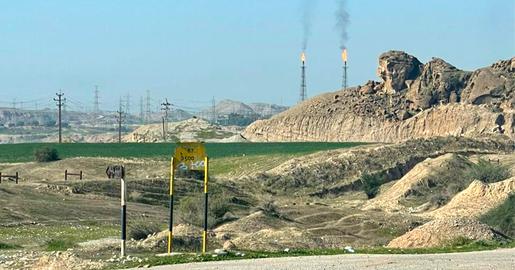
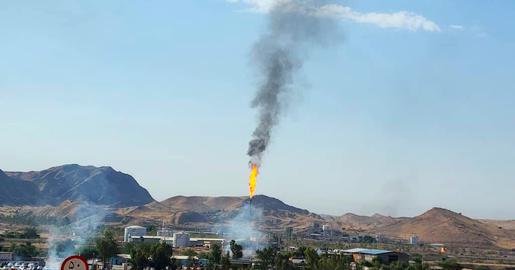
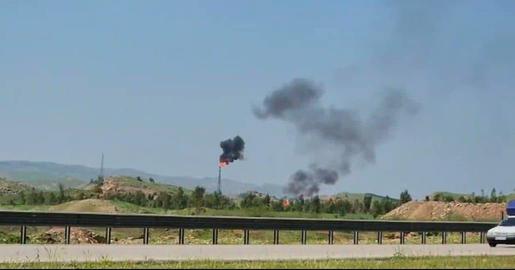
Images obtained by IranWire reveal that all 52 flaring stacks, which were supposed to be decommissioned between 2018 and 2021, remain active. The blue flames indicate the presence of acidic compounds.
Shahrokh explained, “While the economic losses from burning these gases have been estimated, the health and agricultural damage remain under-researched.”
These flaring stacks are located in the cities of Behbahan, Zeydun, Aghajari, Omidiyeh, and Ramhormoz in Khuzestan, as well as Gachsaran in Kohgiluyeh and Boyer Ahmad. They are tied to the Marun, Gachsaran, Aghajari, and Rag Sefid oil fields.
The Ebrahim Raisi administration had pledged to stop the flaring by mid-2025, but a recent parliamentary visit revealed that the promise remains unfulfilled.
According to the Naft-e-Ma website, quoting the production manager of the National Iranian South Oil Company, over 90 percent of the flaring stacks in the southern oilfields are expected to be collected by end of 2025. Flaring also continues in West Karun, mainly linked to oil facilities in the Azadegan field within the Hor al-Azim marshes.
Reports from the Oil Ministry and the Energy Commission of Parliament indicate that in 2022, Iran flared around 18.43 billion cubic meters of gas, accounting for about 12 percent of global flaring.
This volume nearly equals Iran's total natural gas exports in 2021.
Furthermore, gas production at Phase 1 of South Pars that year was around 9 billion cubic meters. Assuming an average gas price of 15 cents per cubic meter, the economic loss from this flaring amounts to nearly $3 billion annually.
A report by Sedigheh Torabi, Deputy for Human Environment at Iran's Department of Environment, notes that Khuzestan and its capital have been the most polluted areas in the country over the past three years.
The composition of pollutants in Khuzestan differs significantly from those in cities like Tehran, Mashhad, and Isfahan.
Additionally, Behbahan has frequently ranked among the world's top 10 most polluted cities during this time, often emerging as the most polluted city in the province.
Unlike Ahvaz, which suffers from a combination of dust storms, burning sugarcane fields during harvest, and flaring from oil facilities, Behbahan was once known for its favorable climate.
The city is surrounded by three rivers - Marun, Zohreh, and Kheirabad - but has faced repeated closures due to air pollution this year.
The primary source of pollution in Behbahan is the operation of the Bidboland Persian Gulf Petrochemical Complex and the flaring of sour gases.
Hajir Kiani, an environmental activist from Khuzestan, told Payam-e-Ma newspaper, “According to data from the Department of Environment and Khuzestan's provincial environmental office, 60 percent of air pollution in
Ahvaz is industrial. Of this, 70 percent is related to oil and petrochemical activities."
"In Ahvaz, the most significant pollutants come from oil flares containing 250 toxic substances per cubic meter, as documented in 200 international scientific studies. In contrast, countries along the southern shores of the Persian Gulf have controlled up to 98 percent of their flares."
Behbahan, due to its geographical location, has the potential for agriculture and animal husbandry. However, instead of investing in these sectors, the city has become the water-consuming and polluting petrochemical industry host.
Shahrokh, the environmental activist from Khuzestan, said, “According to higher-level regulations, petrochemical plants should be located near the sea and close to fuel and feedstock sources."
"The location of the Bidboland petrochemical plant contradicts these guidelines. The main reason for this is the influence of the then-member of parliament and organizations like the [IRGC's] Khatam al-Anbia headquarters, which had the operational capacity for initial construction and equipment installation.”
Shahrokh added that this issue is not limited to the Bidboland plant. The construction of petrochemical plants in regions like Kohgiluyeh and Boyer Ahmad, far from the sea and without proper fuel and feedstock access, is also the result of political influence.
He further pointed to the untreated wastewater from the petrochemical complex, saying, “While there may have been research on heavy metals found in agricultural products near the refinery, we are still unaware of the impact of its effluents on the soil and water in the region.”
This year, Behbahan faced multiple closures due to air pollution, and the city frequently appeared in the red zone for air quality on national monitoring systems.
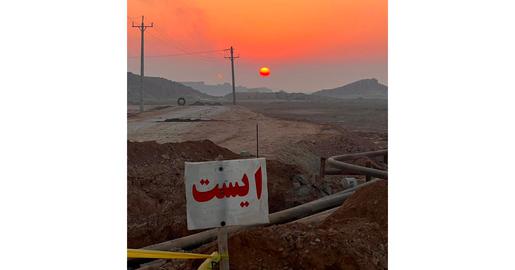
For the people of Khuzestan, each sunset brings not just darkness but the stark illumination of dozens of flares, burning like warning beacons of an environmental tragedy unfolding in slow motion.
As residents close their windows against the acrid air, they confront a grim reality: their province's wealth has become their health's greatest threat.

Interested in writing for IranWire?
Share your stories.



comments