



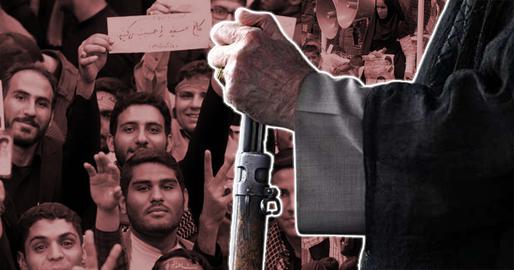
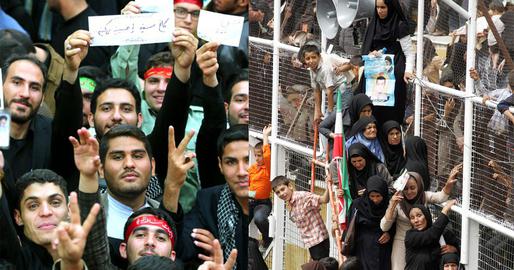


Some hardline groups in Iran are urging Supreme Leader Ali Khamenei to declare jihad against Israel and the United States.
In several Iranian cities, Basij militiamen on motorcycles cruise through the streets chanting, "Woe if Khamenei gives me the order for jihad."
Despite mounting pressure, Khamenei has called for patience. In a speech on July 16, he said, "Impatience is harmful. When people keep stamping their feet, saying, 'Sir, why didn't it happen? Why didn't you act?' - this is harmful."
Even as he urges restraint, the concept of "jihad" has reemerged at the center of both official and public discourse in the Islamic Republic, amid regional tensions and recent conflicts with Israel.
From fatwas and official statements to elegies and social media hashtags, the meaning of jihad has been reframed and now influences politics, security, media, and the economy.
Calls for a formal fatwa peaked following the publication of a religious decree by Nasser Makarem Shirazi, a prominent Shia religious authority.
Responding to a religious inquiry about threats made by the U.S. president and the Israeli prime minister against Iran's Supreme Leader, Makarem Shirazi wrote that any individual or regime that threatens Khamenei and religious authority "is waging war against God," and "any cooperation or strengthening of it" is "forbidden" for Muslims.
He added that Muslims must make such enemies "regret their words and mistakes" and that those who "suffer hardship or loss" in this cause will receive "the reward of a mujahid in the way of Allah."
Following the release of the fatwa, which some view as laying the groundwork for a jihad decree, over 400 members of the General Assembly of the Society of Seminary Teachers in Qom issued a statement in support, calling the fatwa "historic and courageous."
They called on "all free and brave nations, especially Muslims worldwide," to rise "for the salvation of humanity, to strengthen the glory and greatness of Islam, and to destroy the terrorist regimes of Zionist Israel and the United States." They called for "jihad and struggle" for the salvation of "the world's oppressed."
On July 7, over 100 professors from Qom Seminary issued another statement, declaring that any "insult against the sacred position of the leader of the nation" constitutes a call for "great jihad."
Some within the Islamic Republic frame the idea of "resistance" as a form of jihad intended to achieve peace. Alireza Abadi, the Supreme Leader's representative in South Khorasan, said, "Jihad and resistance against oppression and colonialism are not just defensive necessities - they are investments in divine justice and lasting peace."
Numerous religious and intellectual figures have supported the idea of issuing a fatwa for jihad, emphasizing its perceived strategic and spiritual importance.
Amin Asadpour, a scientific board member at the Raseen Foundation, described the Iran-Israel conflict as "a war of existential nature," adding, "In this existential battle, explaining the theology of jihad and struggle and protecting borders is an important mission of the clergy."
He continued, "Jihad is a powerful armor and shield that protects society, whose abandonment clothes people in humiliation and deprives them of justice. This concept must find the first coefficient in society."
Zabihullah Naimian, director of the Imam Reza Seminary Higher Education Institute, approaches the subject from a jurisprudential perspective. He believes "Islamic jurisprudence has a vast scientific capacity in the areas of defense and jihad, but due to a relative lack of wars in recent centuries, it has been underexplored."
However, he added that "the boundaries of war, the timing for waging jihad, and when to declare a ceasefire must be determined within the framework of expediency."
Bijan Abdolkarimi, a philosophy researcher and supporter of the Islamic Republic, said in a video that the 12-day war is "a battle between the human and the inhuman," describing Israel and the U.S. as symbols of "savagery and barbarism."
He called Iran "the only hope of the world's free people," adding, "A blow to Iran is a blow to humanity."
Political activist Emadoddin Baghi warned U.S. President Donald Trump that if Shia and Sunni authorities were to issue jihad fatwas simultaneously, "the command would transcend Iran's borders and extend from Turkey, Afghanistan, and Pakistan to Jordan, Bangladesh, Africa, and even the West."
This mirrors a type of jihad promoted by ISIS, which framed it as a total struggle - military, ideological, and political - meant to establish their so-called caliphate through violence, propaganda, and strict religious law.
In this interpretation, jihad is not merely defensive - it's a duty to initiate an attack. Western governments view this as terrorism and a serious threat to national and global security.
This rhetoric alarms Western nations, particularly when Iranian officials like Mohammad Javad Larijani say on national television, "Europeans can no longer move freely; maybe in a few days, five drones will hit a European city."
After Hamas's October 7, 2023, attack, one performer recited a poem saying, "Woe if Khamenei gives me the order for jihad, the world's armies couldn't stop me."
That poem has recently resurfaced and is widely circulating on social media channels associated with Iran's hardliners.
Islamic Republic supporters on social media have increasingly used threatening language surrounding the possibility of a jihad fatwa.
A popular poem reads, "We, lovers of Ali, defend the oppressed and fight the oppressors. If the leader orders jihad, may your cursed life and those like you end." The atmosphere feels tense, as if people are waiting for a command they believe could alter the course of history.
One supporter wrote, "Iran's military strength isn't just in weapons - it's in people ready to die, in a leader's fatwa calling for jihad, in the faith behind the trenches. America doesn't understand this." Another added, "If the order comes, Ashura won't be repeated - it will change history."
A different user warned, "A defensive jihad fatwa knows no borders. War with Iran means war with the entire Islamic nation."
Another wrote, "The jihad fatwa isn't just a religious order; it's part of Iran's national strategy."
Many regime supporters believe such a fatwa would ignite a global movement. "This fatwa lights a fire in the hearts of nations - with one signal, millions are ready to turn the enemy's pride to ashes," one wrote.
Women who support the Islamic Republic have also joined the chorus.
One wrote, "We are the leader's daughters, waiting for his command. If he orders jihad, we will destroy our homeland's enemies."
Another echoed, "We are the leader's daughters. If he gives the order, we will stand alongside the army and the Revolutionary Guard to defend our country."
The concept of declaring jihad isn't just a current issue for Muslim societies opposed to Israel and the United States - it has a long historical weight in Islamic history.
In the late 19th century, Sultan Abdul Hamid II (1842–1918) frequently threatened Europe with a "jihad fatwa," though he never formally issued one.
His daughter, Ayşe Osmanoğlu, wrote in her memoirs that her father used to say there was "one word between my two lips" that, if spoken, "would cause the world to collapse."
However, she added that he was cautious about using such a command and thought to himself, "If I give the command and no one responds, the caliphate's prestige will collapse."
Soon afterward, in 1914, Sultan Mehmed Reshad did issue a jihad decree when the Ottoman Empire entered World War I. However, the call failed to elicit a strong response from the wider Islamic world.

Interested in writing for IranWire?
Share your stories.


comments