



The Revolutionary Guards: An Introduction
The Islamic Revolutionary Guard Corps (IRGC) is the Islamic Republic of Iran’s most important institution. The military-security institution commands huge influence in every aspect of Iranian public life, from culture and the environment to the economy, politics and judicial process. Whatever the field or area, the IRGC is not required to report to anybody and is answerable to no one.
The IRGC was created early after the 1979 Islamic Revolution by the order of the founder of the Islamic Republic, Ayatollah Ruhollah Khomeini. Its declared mission was to safeguard the revolution and its accomplishments. As the years have gone by, it has expanded its sphere of activities. The entities under its control have multiplied to such a degree that it now operates effectively as a parallel government. It interferes in all current affairs of the country and it aims to have control over every aspect of the way Iran is run.
In a series of reports, IranWire presents a detailed portrait of this powerful and mysterious institution and, for the first time, identifies and explains all bodies, institutions and other entities operating under the umbrella of the Revolutionary Guards, at the same time outlining its activities through an infographic and an interactive diagram.
The infographic is a visual representation of the Guards’ organizational structure and presents all institutions under the control of IRGC in one map. It resembles a family tree, a portrait of the IRGC with all its children, grandchildren and great-grandchildren — a dramatic picture of power in Iran today.
In the interactive diagram, the viewer is able to use the mouse to see how various entities under the control of the Guards emerged, and how they are connected — exactly like a family tree.
IranWire has aimed for this series and the overall project to be informative and a solid research tool. But it is not perfect, and there will always be room for updates, enhancements and further information. We welcome your views, ideas and knowledge, so please do get in touch via email, Twitter or Facebook.
***
IRGC Provincial Corps
The IRGC Provincial Corps was established in 2008 under orders from the IRGC’s chief commander to decentralize the organization and empower local commanders across Iran. This initiative transferred Basij Resistance Districts from Basij control to the IRGC and reorganized the IRGC Ground Forces in each region into 32 provincial corps, each led by a commander appointed by the IRGC chief commander. The intent, as outlined by the IRGC’s Strategic Center and approved by Iran's Supreme Leader, was to strengthen local IRGC forces’ authority.
This reorganization provided each corps with more autonomy and led to the creation of financial, cultural, and social units. Tehran Province, given its population and significance, has two IRGC corps: the Mohammad Rasoul-Allah Corps, overseeing Tehran and Shemiranat, and the Seyyed-al-Shohada Corps, responsible for smaller towns and villages within the province. In 2009, following Iran’s contested presidential election, the Mohammad Rasoul-Allah Corps was tasked with containing protests in Tehran as directed by the Supreme Council of National Security.
Subunits of the Corps are Beit-al-Moqadas Rapid Response Battalion (men) and Al-Zahra Battalion (women), which are ready-to-fight units, and Ashura Battalion (men) and Al-Zahra Battalion (women), which are back-up units. Imam Ali Security Battalion is another active unit and is tasked with suppressing civil unrest and riots. Imam Hossein Battalion is tasked with defending the country against foreign and security threats. At the end of 2015, there were estimated to be around 500 battalions in total.
The IRGC Ground Forces have 32 provincial corps in Iran’s 31 provinces:
- Mohammad Rasulullah Corps (Tehran)- This is the largest IRGC provincial corps, tasked with safeguarding the capital. It was formed in 2007 through the merger of the Mohammad Rasulullah 27 Division and Tehran’s Sar-Allah Headquarters. Brigadier General Hassan Hassanzadeh has led the corps since 2020. Previously under the command of General Abdollah Araqi, the corps played an active role in suppressing protesters in Tehran during the 2009 election protests, after which the Supreme National Security Council granted the city’s command to the corps. However, after the 2017 Daesh terrorist attacks, this corps and Sar-Allah Headquarters were separated into independent commands.
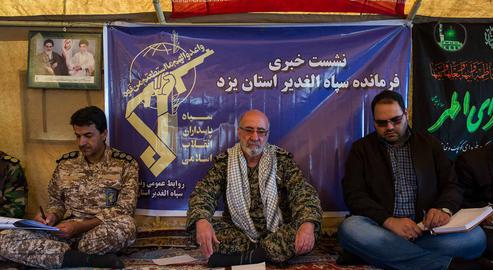
- Al-Qadir Corps (Yazd): Commanded by General Hossein Zareh Kamali, the Al-Qadir Corps oversees Yazd province. It engages in development projects, including building mosques, maintaining schools, and expanding infrastructure, and provides medical services to underserved areas. The corps has also been active in protest suppression, including the 2017-2018 economic protests, the 2019-2020 fuel price protests, and the 2022 “Woman, Life, Freedom” movement after the death of Mahsa Amini in the custody of the morality police.
- Imam Hassan Mujtaba Corps (Alborz): Led by General Alireza Heydar-Nia, this corps focuses on security in Alborz province. Like others, it is involved in construction and repairs for local mosques, schools, and bridges and provides medical support to underserved regions. The corps too played a role in suppressing the 2017-2018 and 2019-2020 protests, as well as the 2022 protests following Mahsa Amini’s death.
- Imam Reza Corps Imam Reza Corps (Razavi Khorasan): Commanded by General Hashem Ghiasi, this corps provides infrastructure and medical services through the Basij and Shahid Brounesi Headquarters. The Corps has been actively involved in suppressing protests, including those in 2017–2018, in 2019-2020, and during the 2022 “Woman, Life, Freedom” movement.
- Imam Sajad Corps (Hormozgan): Based in the south coastal province, General Abazar Salari leads this corps. Besides participating in construction and infrastructure projects and providing services to the poor, it has also been active in helping the population during natural disasters. The corps played a role in protest suppression, especially in the 2022 “Women, Life, Freedom” national movements.
- Imam Sadeq Corps (Bushehr): Commanded by General Ali Razmjoo, this corps in Persian Gulf, focuses on poverty alleviation, including constructing housing, schools, health units and mosques. Like other units, it was active in suppressing protesters in the 2017–2018, 2019-2020 and the 2022 “Woman, Life, Freedom” nationwide protests.
- Amir-al-Momenin Corps (Ilam): Led by General Seyed Sadegh Hosseini, the corps in western province, is involved in local infrastructure and natural disaster relief. The corps is responsible for helping the victims of natural disasters such as floods and earthquakes. It has also been engaged in protest suppression just like other corps.
- Ansar-al-Reza Corps (Southern Khorasan): In the eastern province of Southern Khorasan, General Mohammad Reza Mahdavi commands the unit. In 2019, his predecessor General Ali Qassemi announced that the corps had inaugurated 750 infrastructure projects in the province. In the same year, he also announced the formation of a coordination center along with a unit that would deal with social problems and poverty in the province. Besides maintaining security in the province, the corps is also active in infrastructure projects, providing medical services to underprivileged areas and helping the victims of natural disasters. Ansar-al-Reza Corps has also been actively involved in suppressing protest such as those in the 2017–2018, 2019-2020 and during the 2022 “Woman, Life, Freedom” movement.
- Ansar-al-Hossein Corps (Hamedan): Under General Mazaher Majidi, this corps undertakes extensive rural development, medical services, and disaster response. In 2019, Majidi claimed that the corps had implemented 1,040 projects in rural water and sewage, agricultural irrigation, the revival of qanats (underground aqueducts) and school reconstruction. Ansar-al-Hossein Corps also actively participated in suppressing anti-government protests.
- Ansar-al-Mahdi Corps (Zanjan): Under General Jahanbakhsh Karami, this corps is involved in poverty alleviation projects, including irrigation and health services. In 2018, Karami announced that the corps, in cooperation with the IRGC Poverty Alleviation Headquarters, implemented more than 620 poverty alleviation projects involving irrigation, drinking water, repairing schools and the development of infrastructure. Ansar-al-Mahdi Corps has been also actively involved in cracking down on dissent and controlling protests.
- Beit-al-Moqadas Corps (Kurdistan): Commanded by General Sadegh Hosseini, this corps was originally formed during the Iran-Iraq War. It is one of the most powerful and important security forces in this province. It is central to security efforts in Kurdistan, where armed clashes with Kurdish separatists are frequent. In 1996, the Democratic Party of Kurdistan agreed to cease its military activities inside Iran. But in 2018, a new wave of clashes occurred between the party and IRGC members causing the deaths of 20 IRGC members and 11 Kurdish rebels. And in September 2018, the corps confirmed that it launched a missile strike against the headquarters of the KDP in Iraq. The strike reportedly killed 15 people and wounded 50 others.
- Besides its security duties, the Beit-al-Moqadas Corps is also active in development and infrastructure projects, building mosques and schools and providing medical service to the underprivileged areas. It remains active in suppressing protests such as those in the 2017–2018, 2019-2020 and during the 2022 “Woman, Life, Freedom” movement.
- Sar-Allah Corps (Kerman): General Mohammad Ali Nazari leads this large unit in the southern province of kerma. The corps oversees coordination and preparation of Basij forces. According to its former commander General Gholam-Ali Abuhamzeh, the corps organizes 30,000 Basij forces in two districts of Hazrat Rasul and Hazrat Amir-al-Momenin, including the Basij branches in various professions and neighborhoods.
- Recently, the commander of this force claimed that 200 specialist doctors have provided their services to the people of five cities in the province for free through his organization. Like other units of its kind, Sar-Allah Corps continues to play a crucial role in quelling dissent in the region.
- Javad-al-Aeme Corps (Northern Khorasan): Commanded by General Esmail Faraji, the corps works on infrastructure and development projects while providing health services. The Corps also actively participated in protest suppression during 2017–2018, 2019-2020 and even during the 2022 “Woman, Life, Freedom” movement.
- Hazrat Abulfazl Corps (Lorestan): Commanded by General Nematollah Bagheri in western province, this corps completed thousands of projects focused on health, education, and infrastructure, using jihadi groups for implementation.
- Hazrat Abbas Corps (Ardabil): Commanded by General Gholam Hossein Mohammadi-Asl in western province, this corps engages Basij battalions for internal security. In 2016, his predecessor General Jalil Babazadeh told the Mehr News Agency that the Basij was implementing programs for education, ideological and religious teaching as well as poverty alleviation and construction projects. He said that the corps was providing complementary training for more than 1,000 Basijis in the battalions in the same year.
- Hazrat Qamar Bani-Hashem Corps (Chaharmahal and Bakhtiari): General Ali Mohammad Akbari heads this unit ensuring security in southwestern province. The corps is active in infrastructure, medical services, and protest control.
- Hazrat Nabi Akram Corps (Kermanshah): Under the command of General Bahman Riahi, it organizes Basij activities for community support. These activities include organizing camps for pilgrims at holy sites. In 2019, Riahi told the media about the inaugurating 44 residential units in the province hit by the 2017 earthquake.
- Ruhollah Corps (Markazi): Commanded by General Morteza Amu-Mehdi, it focuses on poverty alleviation and supporting Arba'een pilgrims. The Corps’ mission is to aid poverty alleviation based on the resistance economy model. It mobilizes Basij forces to run programs in job creation, the establishment of housing to help the poor and the inauguration of resistance bases and sport and cultural centers. The corps was given the task of hosting Pakistani pilgrims for the occasion of Arba’een, a Shia holy day. Salaman Corps (Sistan and Baluchistan): Led by Brigadier Ahmad Shafaei, it mobilizes Basij forces for drills and gatherings.
- Seyyed al-Shohada Corps (Tehran province): Headed by General Ghorban Mohammad Valizadeh, this corps manages Basij bases throughout Tehran province, excluding the capital. The corps was previously commanded by Brigadier Shahcheraqi for less than a year and Ali Nasiri who held the post for six years. Shohada Corps (Western Azerbaijan): Commanded by General Mohammad Hossein Rajabi, it organizes medical and infrastructure support in rural areas. The corps mobilizes Basij forces through the organization of exhibitions, sending medical teams and jihadi groups to the deprived areas and organizing political congregations called enlightenment (roshangari) gatherings. The corps contributes to small development projects such as providing electricity to villages in the province.
- Saheb-al-Amr Corps (Qazvin): Led by Brigadier Rostam Ali Rafiei Atani, it focuses on regional security and support initiatives.
- Saheb-al-Zaman Corps (Isfahan): General Mojtaba Fada commands this unit, which has worked on anti-profiteering campaigns and criticizing corrupt policies. The corps contributes to small construction projects and sends jihadi groups comprising of engineers, clerics and students to deprived areas. It establishes jihadi camps where several projects (such as water supply, drinking water and restoration of Shia prayer halls) are implemented. Following the 2018 economic crisis of 2018, the corps highlighted 26 cases of hoarding in Isfahan, worth eight-thousand billion rials.
- Ashura Corps (Eastern Azerbaijan): Commanded by General Asghar Abbas-Gholizadeh, it runs poverty-alleviation projects. In 2019, former commander Zein al-Abedin Khorram told the media that the corps was forming a convoy for economic help and reconstruction in Syria. According to Khorram, the convoy was the first of its kind in Eastern Azerbaijani province and was aiming to invite investors to engage in reconstruction and generate profit for Iranian companies.
- Ali-ebn-Abitaleb Corps (Qom):This corps is commanded by General Mohammad Reza Movahed.
- Fath Corps (Kogiluye and Boyer-Ahmad): Commanded by General Hamid Khorramdel, who previously served as deputy commander of the Imam Sadegh Corps in the province of Bushehr and also as a head of student Basij. He was also commander of Malek Ashtar Corps and the deputy intelligence and deputy commander of the Imam Sadegh Corps in the same province.
- 27.Fajr Corps (Fars): Commanded by General Yadollah Bu-Ali, this corps is involved in relief and development work, especially post-earthquake aid, including medical services and food distribution to victims in Fars province. In 2017, his predecessor General Seyyed Hashem Ghiasi announced that the Fajr Corps is considering allocating credits to 14 deprived areas in the province. In the aftermath of the 2017 earthquake in Fars province, the corps announced that it had provided relief services to the earthquake victims. Ghiasi announced that the Basiji groups were active in medical services, counseling and distribution of food and hot meals to the victims.
- 28.Qaem Corps (Semnan): Colonel Hamid Damqani leads this unit, recently establishing 46 neighborhood Basij zones and overseeing 600 Basij bases, with extensive community participation in local activities. The Basij bases provide membership to 212,000 people in the province.
- Quds Corps (Gilan): Headed by General Hamid Damghani, this corps manages annual Basij and IRGC exercises and organizes jihadi groups for assistance in deprived areas. In 2018, the corps organized four battalions from Kowsar and Beit-al-Moqadas for the Ashura exercises in the district of Astara.
- Karbala Corps (Mazandaran): General Siavash Moslemi oversees poverty alleviation projects and housing initiatives through Basij mobilization, involving local professionals in economic and social development. In the words of its former commander General Mohammad Hussein Babaie, “Over 6 million people have been involved in the economic sector from the ranks of college students, workers, physicians and engineers.”
- Neinava Corps (Golestan): Led by General Ali Jomeh Malek-Shahkouhi, it implements projects to support villages, providing water, agriculture support, and building schools and sports facilities.
- Valiasr Corps (Khuzestan): Commanded by General Hussein Shahvarpur, it supports "Voyagers to Light" pilgrimage programs, maintaining regional security and assisting visitors.
The Commander in Chief of the Armed Forces
The Chief Commander of the IRGC
The Supreme Leader’s Representative in the IRGC
The IRGC Security and Intelligence Agencies
The IRGC's Social, Cultural, Scientific and Educational Institutions
The IRGC Commercial and Financial Institutions-(Khatam-al-Anbiya Construction Headquarters)
The IRGC Commercial and Financial Institutions-(Bonyad-e Ta’avon-e Sepah)
The Organization for the Mobilization of the Oppressed
The Basij Cooperative Foundation
Cyberspace Institutions and The Physical Training Organization of the Basij
Basij Headquarters and Military Organizations
Basij Social and Cultural Organizations
Interested in writing for IranWire?
Share your stories.


comments