



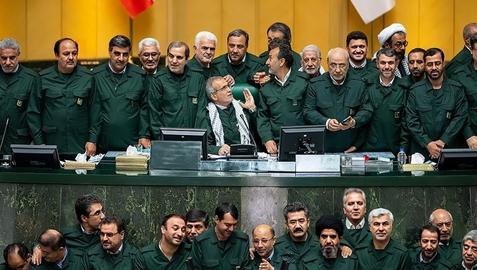
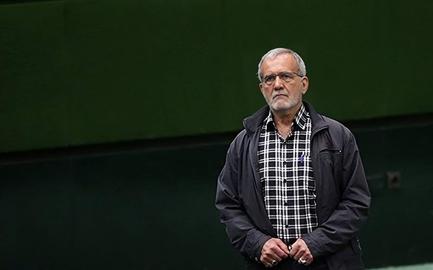
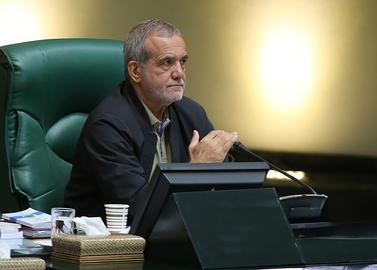
A review of Masoud Pezeshkian's record in the Iranian Parliament, where he served as a representative for four terms, shows that he has consistently addressed similar concerns over the years.
One of his key focuses has been implementing plans according to the wishes of the Supreme Leader of the Islamic Republic.
Despite this, some voters viewed his previous statements with concern and saw him as a changed person due to his new rhetoric during the elections.
One of his main concerns was his support for the Cultural Revolution, which followed the 1979 Islamic Revolution. In the name of the revolution, around 8,000 professors and students were dismissed.
In a 2021 interview, Pezeshkian supported repressive measures against dissidents and the dismissal of opposing students and professors.
He said, "When I was a student, I was in charge of the Islamic Association, I was responsible for selection; responsible for cleansing."
During his tenure as Minister of Health, he also facilitated the ban on admitting male students to women's medical fields.
Some view this as aligned with his traditional religious beliefs about women and hijab, a stance he maintained during debates, especially when he said, "The root of the issues raised about women is in school, and if necessary education is provided in schools, these tensions and social problems will no longer arise."
However, many of his supporters believe he opposes the actions of the Morality Police.
He wrote on the X during the election campaigns: "I guarantee that the entire government will stand against forced patrols, internet filtering and external pressures in all meetings."
Controversial Speeches
In 2020, Pezeshkian protested his disqualification from the parliamentary election, declaring, "I want the Guardian Council to publicly say why I was disqualified." He emphasized, "I have not been looking for worldly gains, which is why I can speak freely against the oppressor."
He added, "I did not run a medical office, and I was never looking for money, power, or status, and I never will."
He warned, "People do not say good things behind me," stressing the danger facing the nation, which he described as "everyone's property."
Pezeshkian stressed that the president should be a role model and embodiment of the Iranian nation, being fair to bothfriends and enemies.
He pointed out the injustices in Iranian society related to politics, economy, and ethnicity and advocated for necessary reforms.
In 2009, during a speech about the events of that year, he quoted Mohammad Beheshti: "I prefer a bitter and honest approach to the sweetness of a hypocritical approach," adding, "In the Islamic system, even Ali [first Shia imam] must go to court."
He lamented that in society, people easily slander and dishonor others without legal recourse.
He said that people should be treated with forgiveness if they make accidental or intentional mistakes: "If we treat people fairly, many of the country's problems will be solved."
In 2018, amid criticisms and accusations regarding his daughter's employment at Jam Petrochemical, Pezeshkian defended his family and asserted, "My daughter has been working legally and based on her merits in Jam Petrochemical. No rent or special treatment has been involved in this issue."
He condemned these accusations as unsubstantiated attempts to destroy his and his family's reputation.
Pezeshkian emphasized the importance of transparency and justice, stating, "If there is a violation in this field, it should be dealt with legally. I have always believed in transparency and justice, and we have followed the same principles in all my and my family's affairs."
"I Don't Consider Impeachment Useful"
In the early months of the 8th Parliament, he defended the credentials of Salman Khodadadi, the representative of Malekan.
The commission of inquiry initially rejected Khodadadi's credentials due to charges of "rape" and "sexual harassment."
However, Pezeshkian argued in a session, "Preachers advise for good in public but in privacy, they do something else."
This speech deeply offended Mohammed Ebrahim Nekonam and Ruhollah Hosseinian, who opposed Khodadadi's credentials, leading to intense debates in the Parliament.
Some accused Pezeshkian of supporting an "immoral" person, but he demanded evidence to back these accusations.
Pezeshkian also participated in some controversial parliamentary impeachments as a defense minister. He noted, "I never signed the impeachment of any minister during the years I was in parliament because I do not consider this method of impeachment of ministers useful."
During the impeachment of Ali Rabiei, the Minister of Labor, who faced pressure due to management issues and accusations of corruption, Pezeshkian managed the meeting.
Rabiei ultimately won another vote of confidence with a narrow margin, but representatives like Mohammadreza Pourebrahimi were very dissatisfied with Pezeshkian's defense of Rabiei despite the alleged infractions of Rabiei's children.
In the impeachment of Abbas Akhondi, the Minister of Roads and Urban Development, the criticisms included, "In the last five years, not a single social housing unit has been handed over to the applicants," "out of 200 airplanes purchased, only seven have reached us," "the country's roads have become death traps," and "how many accidents must happen for you to realize you are not qualified for the ministry."
In response, Pezeshkian defended Akhondi, stating, "Our fleet, airplanes, and railways are old. If Akhondi leaves and another minister comes with this old fleet and these credits at the ministry's disposal, miracles will not happen."
Akhondi was able to secure a vote of confidence from Parliament during that period.
During the impeachment of Mahmoud Hojjati, the Minister of Agricultural Jihad, and Masoud Karbasian, the Minister of Economic Affairs and Finance, Pezeshkian was part of the parliamentary committee opposing the impeachment.
He emphasized the need for a deeper investigation into economic problems, stating, "Problems cannot be solved with emotions and chanting, problems must be rooted out."
"Foreign Policy is Field of Bargaining and Dealing"
Pezeshkian, a surgeon by training, holds a pragmatic view of foreign affairs, seeing them as a field of bargaining and negotiation rather than rigid ideologies.
In 2020, he said, "Foreign policy is a deal." He emphasized that his stance on foreign policy aligns with the Supreme Leader's position.
Pezeshkian also highlighted the importance of peace and negotiation, quoting the first Shia imam: "You should accept the peace that your enemy invites you to."
Regarding a cooperation document between Iran and China, Pezeshkian supported the policy of engagement with the East, describing it as correct despite criticism from the United States and Israel.
He remarked, "I don't know why this document is not transparent, but it seems to me that it was expedient."
Pezeshkian has been a vocal critic of Israel. In March, he stated, "The Zionist regime cannot do anything other than killing children. The response of the Islamic Republic of Iran to the actions of the Zionist regime must follow planning and thought to destroy this regime's plans and conspiracies."
In 2018, Pezeshkian condemned Western sanctions, questioning the logic behind punishing people for political disputes.
He said, "If you have a fight with politicians, why do you deal with innocent people?" he added, "Certainly, anyone who is indifferent to people's pain is far from humanity."
Money Laundering and Push for Domestic FATF
Pezeshkian believes that the failure to effectively implement Article 44 of the Constitution and the directives of the Islamic Republic's leader regarding strengthening the private sector and cooperatives have significantly contributed to the country's economic issues.
In January, Pezeshkian highlighted, "Not giving space to the private sector, lacking support for it, combined with weak international communication and trade, and inadequate implementation of FATF (Financial Action Task Force) regulations are among the primary causes of the country's economic problems and challenges."
Presently, there is speculation that Ali Tayebnia might lead the economic team in Pezeshkian's cabinet.
As a supporter of the FATF protocols, Pezeshkian acknowledges the presence of money laundering in the country. He said, "Foreign FATF pointed out that we have money laundering issues, and they were correct."
He advocates for establishing a domestic FATF to tackle corruption and rent-seeking, stating, "If we had implemented the FATF mechanisms, we would have prevented the embezzlement of thousands of billions."
He also emphasizes that without signing FATF protocols, Iran would face obstacles in bank exchanges with China.
Non-Implementation of Laws
During his tenure in Parliament, Pezeshkian consistently highlighted the critical role of law implementation in addressing social justice and economic problems.
He has argued that the failure to enforce existing laws significantly contributes to these issues.
In 2023, Bishidian said, "We were supposed to address housing issues for people, but the authorities have only implemented 25 percent of the program and budget law. Instead of drafting new laws, we need to focus on implementing the existing ones."
Regarding family and population policies, Pezeshkain has stressed that merely providing facilities is insufficient.
He believes tangible solutions, such as employment opportunities and housing for the youth, are essential.
He noted, "Providing facilities alone will not solve the issue. We need to create job and housing opportunities for the youth. After all, should they return this money or not?"
Pezeshkian also advocates respecting citizens' rights to protest and express their grievances legally.
He stated in 2021, "According to the law, everyone has the right to protest, and these protests should be legally sanctioned. Unfortunately, the Islamic Republic has not permitted such protests if they conflict with the views of policymakers."
Regarding university affairs, Pezeshkian supports maintaining a free academic environment.
He opposes the involvement of security forces in universities, advocating for control by students, faculty, and professors instead. He said, "Universities should be governed by their students, faculty, and professors."
While condemning insulting slogans and violent behaviors, he has defended the presence of security forces in specific contexts, stating, "Insulting slogans cause tension and conflict. We need to avoid such behavior. However, when individuals insult others' beliefs, it is expected that conflicts may arise."
In response to the protests and violence following the death of Mahsa Amini in 2022, he said, "We must pursue the issue of Ms Amini with determination, addressing it according to the law and Sharia. However, some protesters, who insulted leadership and engaged in violence, appear to have been influenced by foreign sources. Such actions are detrimental and serve to undermine our country."
He warns against associating with those who use such movements to challenge the Islamic Republic, emphasizing, "People seeking to assert their rights must distance themselves from those who aim to disrupt and harm our nation.
Interested in writing for IranWire?
Share your stories.


comments