



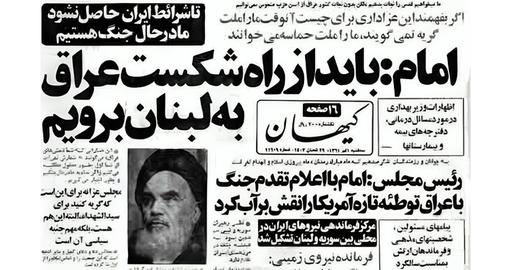

During the 1980s, the United States brokered collaboration between Ruhollah Khomeini, the founder of the Islamic Republic, and Menachem Begin, then Prime Minister of Israel.
Despite the escalating tensions that would later define their relationship, this past collaboration seems almost unimaginable, especially as the possibility of an all-out war between Israel and the Islamic Republic looms larger than ever.
At the time, Khomeini rebuked a group of Islamic Revolutionary Guards Corps (IRGC) commanders heading to Lebanon to fight Israel, cautioning them of the imminent threat posed by Iraq and Saddam Hussein. He declared, "The path to Jerusalem passes through Karbala."
While the public may not have fully understood the significance of this statement then, its implications became clearer in light of the subsequent events.
The relationship between the Islamic Republic and Israel has deteriorated significantly in recent decades, marked by tensions, casualties, and victims. Now, on the anniversary of the Gaza war, the two countries appear closer to war than ever before.
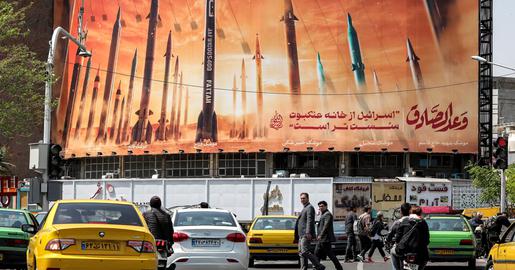
In less than six months, the Islamic Republic has twice targeted Israel with missiles, while Israel has continued its operations to kill IRGC members and its proxy forces, even within Tehran. The drums of war are beating louder than ever.
The current crisis stands in stark contrast to the golden era of cooperation between Iran and Israel before the 1979 Islamic Revolution. During that time, Iran actively supported the Palestinian cause. Even in the 1980s, despite the severe tensions, the collaboration between Khomeini and Begin seems almost mythical in retrospect.
Ideological Conflict and a Secret Alliance
The relationship between the Islamic Republic and Israel in the 1980s is one of modern Iranian history's most complex and contradictory international relations. While one of Khomeini's first acts after the fall of Mohammad Reza Shah was to sever diplomatic relations with Israel, which had existed unofficially at the consular level, a secret alliance between the two countries was formed shortly.
Khomeini's slogan describing Israel as a "cancerous tumor" that "must be wiped off the face of the earth" was widely displayed in Iran.
"Death to Israel" became one of the official slogans of the clerical establishment, chanted in Tehran's Friday prayers. The two countries collaborated secretly despite their public and ideological animosity, especially in military and security matters. These collaborations may have persisted or even intensified after the fall of the Shah, facilitated by intermediaries.
Although these collaborations contradicted Khomeini's public stance, they were formed and driven by shared regional threats and strategic interests, primarily centered around Iraq and its leader, Saddam Hussein.
The Iran-Iraq War and the Need for Secret Collaboration
Before the February 1979 revolution, Israel and Iran had a significant economic and military partnership. Israeli intelligence services and SAVAK had close interactions, with Israeli experts contributing to SAVAK's personnel training and structure. These collaborations extended to various areas, including matters related to Iraq and the Kurds in the north.
When the Iran-Iraq war began in September 1980 with a large-scale invasion of Iranian cities, the Islamic Republic faced a grave existential threat. Khomeini said, "Protecting the establishment is the most important obligation," suggesting that "even religious principles can be suspended" for this purpose. With this worldview, secret collaboration was not considered a red line that could not be crossed.
For the Iranian government, the top priority in foreign and security policy was countering Saddam Hussein and safeguarding the country's territorial integrity. The leader of Iraq had vowed to quickly reach Tehran, capitalizing on Iran's chaotic situation and military disorder.
Following Khomeini's support for the hostage-taking at the U.S. embassy and the subsequent occupation, the Islamic Republic lost military cooperation with the United States, which imposed sanctions. Even before that, the Iranian revolutionaries had terminated several contracts for purchasing weapons and military equipment, including fighter jets.
As the war prolonged, Iran's need for weapons escalated. While Khomeini initially said, "A thief came, threw a stone, and ran away," likening the situation to a fleeting intrusion, it quickly became evident that mere rhetoric could not address the issue.
The growing demand for arms led to secret cooperation between Iran and Israel. However, an unusual event in the first week of the Iran-Iraq war set the stage for an unprecedented opportunity for indirect military collaboration between the two nations.
The Unsaid Military Alliance Between Iran and Israel Against Iraq's Nuclear Facility
In late September 1980, shortly after Iraq's large-scale attack on Iran, the Iranian air force executed a complex operation called "Operation Scorch Sword" to carry out a limited bombing of Iraq's Osirak (Tammuz-1) nuclear facility. The attack disrupted the project's progress, with 400 workers on-site, which was under construction with the assistance of France.
Due to technical limitations, the bombing caused only minor damage to the facility. More importantly, it rendered the facility temporarily unusable due to security concerns for the French personnel. This effectively eliminated the immediate threat of the facility being used in the war.
The Islamic Republic downplayed the attack's significance and did not acknowledge it in its war records. Similar to its current concerns about the Islamic Republic's nuclear capabilities, Israel viewed Iraq's nuclear program as a direct threat to its security. This shared concern led to indirect cooperation between the two countries in their efforts to curtail Iraq's nuclear ambitions.
A year later, Israel carried out "Operation Opera," destroying the Osirak facility. Although there is no credible evidence of direct collaboration between Iran and Israel in this operation, Iran's initial attack on the facility may have influenced Israel's decision to take further action.
Despite their lack of official cooperation, the two countries ultimately achieved their shared goal of neutralizing Iraq's nuclear program.
The Peak of Covert Collaboration With the Hope of 'Strengthening Moderates' in Iran
The Iran-Contra Affair, also known as the McFarlane Affair or Irangate, was the most significant covert collaboration between Iran and Israel during the 1980s. When exposed, this case made headlines and primarily focused on the relationship between the U.S. and Iran, leaving Israel's unexpected role in facilitating arms sales and hostage negotiations under the radar.
In the Iran-Contra Affair, Ronald Reagan's National Security Advisor, Robert McFarlane, traveled to Iran and signed an agreement for the sale of weapons to the Islamic Republic. The U.S. funneled the proceeds from this highly profitable deal to support the Nicaraguan rebels fighting the central government.
Despite the Islamic Republic’s intensely hostile stance towards both the U.S. and Israel, the Iran-Contra arms deal unfolded with the U.S. selling military weapons, including anti-tank missiles and spare parts for fighter jets, in exchange for Iran pressuring Hezbollah in Lebanon to release Western hostages. These weapons were shipped to Iran from Israel. One shipment included a plane carrying TOW and HAWK missiles from Tel Aviv to Tabriz.
A year after the weapons shipment, Keyhan newspaper reported that Israel expected the release of the CIA head in Beirut in exchange. However, the man had already died, and the United States, aware of this fact, had not informed Israel.
Until 2003, it was believed that this was the first shipment of arms from Israel to Iran. However, Akbar Hashemi Rafsanjani told the Hamshahri newspaper that when McFarlane came to Iran, "A substantial amount of weapons was expected to arrive, but only a few containers of essential parts were brought by plane. Some Israeli HAWK missiles were also transported, but they remained at the airport for a long time and had to be returned." He only referred to the return of the Israeli shipment and made no further comment about receiving arms from Israel.
Rafsanjani attributed the rejection of the Israeli arms shipment accompanying McFarlane's visit to Tehran to their "high price." He explained, "They [the Americans] had charged us exorbitantly for the parts. They were demanding an additional five or six million dollars. We only paid 14 million dollars out of the 22 million-dollar deal."
When the deal was exposed in Iran, the primary focus was on McFarlane's secret visit and the covert sale of sanctioned American weapons to the Islamic Republic. However, Israel played a pivotal role in this transaction, hoping that Iran would defeat Saddam, its top security threat.
The weapons shipped from Israel included parts for F-4 and F-5 aircraft as well as anti-aircraft missiles, which Iran desperately needed after four years of war.
Israeli Prime Minister: 'We gave Iran fighter jet tyres'
Beyond the Iran-Contra Affair, Israel and Iran engaged in other covert arms deals. During the Iran-Iraq war, Iran required spare parts for its American military equipment purchased before the 1979 Islamic Revolution.
In early 1980, Israeli Prime Minister Menachem Begin confirmed the shipment of tyres for Phantom fighter jets and other military supplies to Iran. In exchange for this military aid, Ayatollah Khomeini permitted many Iranian Jews to emigrate to the United States or Israel.
The Iran-Contra Affair led to further cooperation between Iran and Israel than the United States had hoped for in improved Iran-U.S. relations. Due to arms embargoes, Iran's access to these parts was severely restricted.
Israel, as a manufacturer and broker of Western arms, supplied Iran with these spare parts with the United States' approval. In essence, Israel assisted Iran in maintaining its military capabilities against Iraq and, at times, even gave Iran a strategic advantage over Saddam Hussein.
Later reports revealed that an arms smuggling network in Israel tried to send weapons and spare parts to Iran during Ali Khamenei’s leadership and Benjamin Netanyahu’s prime ministership in the 2010s. However, these attempts were ultimately unsuccessful.
Cooperation between Iran and Israel during Khamenei's rule was not confined to arms deals. During that period, Iranian oil was sold to Israel through a secret pipeline facilitated by the Swiss trader Marc Rich.
During the 1980s, Israel, in addition to earning revenue from selling arms to the Islamic Republic and securing part of its energy needs, sought to build ties with "moderate" factions within the Iranian government. Israel hoped that these moderates, symbolized by figures like Rafsanjani, would come to power after Khomeini's death, leading to improved relations and enhanced security for Israel in the region.
In addition to these unexpected arms deals, there were reports of intelligence exchanges between Israel and Iran concerning Iraq’s military movements and the regional situation.
The end of the Iran-Iraq war in 1988, the passing of Khomeini a year later, and the beginning of Khamenei’s leadership, coupled with regional shifts such as the collapse of the Soviet Union and Saddam’s weakening, brought an end to the covert collaboration between Iran and Israel.
Following the war and during Khamenei's leadership, the Islamic Republic intensified its anti-Israel policies and openly embraced enmity towards Israel by strengthening support for groups like Hezbollah and Hamas.
Iran's former Foreign Minister Mohammad Javad Zarif, who served from 2013 to 2021, once said, "Israel has turned the Islamic Republic into a security threat, and Iran has played into this narrative, claiming, ‘Yes, I am that threat.’"
Since Khamenei's rule began over 35 years ago, Iran has gradually become Israel’s primary national security threat. The revelation of Iran’s covert nuclear program in the early 2000s marked the start, followed by the escalation of the Syrian conflict, the extensive involvement of the RGC in Syria, and the establishment of multiple bases near Israel, mirroring the experience in Lebanon with Hezbollah, leading to a more severe phase of the crisis.
Israel’s confrontation with the Islamic Republic in Syria has militarized the relationship between the two countries, bringing them to the brink of war today.

Interested in writing for IranWire?
Share your stories.


comments