



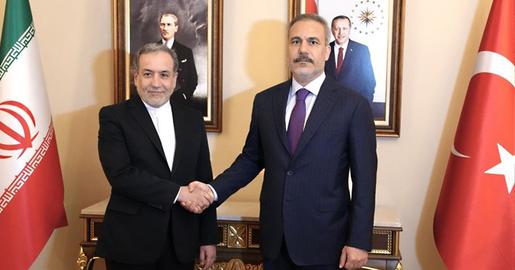
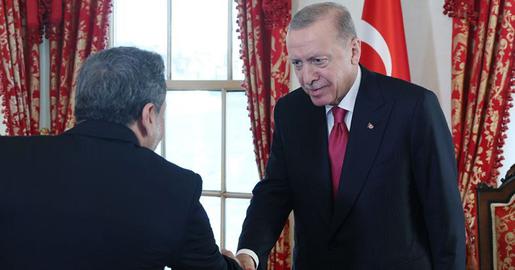
Iran's Foreign Minister, Abbas Araghchi, traveled to Turkey amid soaring tensions in the Middle East. The visit comes on the heels of Iran's missile attack on Israel and the increasing threat of a retaliatory strike on strategic targets within Iran.
According to media sources close to the Iranian government, the visit aimed to coordinate with regional governments and mitigate the escalating crisis.
Israel has faced sharp criticism from Turkish officials and media since the outbreak of the Gaza war last year.
Despite efforts to mend their strained relationship in 2022 after a decade of tension, the war in Gaza reignited hostilities between Turkey and Israel.
The deaths of Ismail Haniyeh, the political leader of Hamas in Tehran, Hassan Nasrallah, the leader of Hezbollah in Beirut, and Yahya Sinwar, the leader of Hamas in Gaza, were a setback to Iran, which provides support to both groups.
In light of these regional developments and the Islamic Republic's warning to neighboring countries against allowing Israel to use their territory to launch an attack on Iran, the Iranian Foreign Minister traveled to Turkey.
Araghchi attended the South Caucasus Regional Cooperation summit in Istanbul, hosted by the Turkish Foreign Minister and attended by the Foreign Ministers of Azerbaijan, Armenia, and Russia (the Foreign Ministers of the 3+3 platform).
The summit, overshadowed by the Islamic Revolutionary Guard Corps (IRGC) attacks on Israel and the looming threat of an Israeli retaliation against Iran, became a secondary event.
During an NTV television interview, Araghchi, when asked by the reporter if the Islamic Republic was prepared for a possible Israeli attack, said, "Any attack is a red line for us. We do not view an Israeli strike as a response to our actions but rather as an act of aggression. We are fully prepared to defend against such an attack.'"
The Iranian Foreign Minister mentioned that "if such an attack occurs, especially targeting nuclear facilities, we will respond in kind. We have already identified all potential targets in Israel. While we are not eager to act, we will not hesitate to do so."
When questioned about why Israel had not responded after 19 days, Araghchi said, "This is due to international pressure on Israel. A large-scale regional war is possible. Also, regional countries are in discussions to prevent a war."
Turkey's Stance on Tensions Between the Islamic Republic and Israel
Araghchi’s regional trips aim to de-escalate tensions and prevent Israel from retaliating against the Islamic Revolutionary Guard Corps' recent missile attack.
A statement released by Iran's Foreign Ministry a few days prior explained that Araghchi's visit to regional countries was part of Tehran's diplomatic efforts to 'end genocide, barbarism, and aggression.'"
In a joint press conference with his Turkish counterpart, Araghchi commended Turkey's position on Palestine. He reiterated the Islamic Republic's threats in a more subdued manner, stating, "Regional countries have told Israel that they will not allow their lands to be used for any potential attacks on Iran. A unified regional voice has emerged in response to the genocide and war.'"
In the press conference, Turkey's Foreign Minister said he had discussed bilateral relations with his Iranian counterpart and expressed Ankara's commitment to expanding trade between the two nations. He added, "Israel threatens to attack Iran's nuclear and oil facilities. Such aggressive stances compel the Islamic Republic of Iran to take legitimate and legal measures.'"
During a television appearance two days ago, he discussed the escalating tensions between Israel and Iran, emphasizing the need for both Turkey and the region to brace themselves for a potential war.
Additionally, during his visit to Turkey, Araghchi also met Recep Tayyip Erdoğan to secure Turkey's support for the Islamic Republic in the event of an Israeli retaliation. He highlighted the mutual solidarity between Turkey and the Islamic Republic in supporting Palestine against Israel.
In response, Erdoğan said, "Israel is actively provocating conflict in the region. The arms sanctions set to be imposed on Israel by the United Nations will effectively counter its actions."
What Do Turkish Experts Say?
Hulki Cevizoğlu, a political analyst and a member of the Justice and Development Party (AKP), said in a television program, "The Islamic Republic will not engage in war with Israel. Following the six-day war of 1967, Arab countries have developed closer ties with Israel and are not seeking to initiate hostilities. Iran, too, is primarily focused on preserving its regime. The war between the Islamic Republic and Israel is largely symbolic. Iran's actions mainly involve issuing statements, a practice it has maintained for years."
Mete Sohtaoğlu, a journalist, discussed the tensions between Iran and Israel. He explained, "Since the death of Qassem Soleimani, twelve of Iran's generals have been killed. Over the past few years, Iran has repeatedly raised black and red flags, vowing revenge. However, it has ultimately engaged in behind-the-scenes negotiations. The deaths of Haniyeh and Nasrallah hold little significance for Iran, which is solely focused on preserving its regime. The Islamic Republic's Shia crescent in the region is now a thing of the past."
Erol Mütercimler'den, an international relations expert, went so far as to say, "If the regime collapses and Iran disintegrates, Turkey will follow suit within an hour."
Does Turkey's Stance on Palestine Indicate a Closer Relationship with Iran?
Over the past decade, tensions between Iran and Turkey have been complex and multifaceted. Despite their shared religious and cultural heritage, the two countries have frequently been at odds on regional and geopolitical matters.
One of the primary areas of disagreement has been the Syrian crisis. While Iran supports Bashar al-Assad's regime as a key regional ally, Turkey has aligned itself with opposition groups and some anti-Assad forces. These differences have contributed to diplomatic tensions and mistrust between the two nations, particularly following the outbreak of Syria's civil war.
Furthermore, Turkey's regional policies have raised concerns for Iran. One such policy, frequently criticized by Iranian officials and media, is Turkey's pursuit of the Zangezur Corridor. This route, connecting Nakhchivan—an autonomous region of Azerbaijan—to Azerbaijan, could reshape the geopolitical landscape of the South Caucasus and potentially diminish Iran's influence in the region. Iran perceives this project as altering the regional balance in favor of Turkey and Azerbaijan, thereby undermining Iran's strategic significance.
Despite these tensions and differences, Turkey and Iran have continued collaborating in certain areas, particularly in the economic and trade sectors. Both countries have maintained their trade relations due to their geographical proximity and economic ties. However, their rivalry for regional influence, particularly in crisis zones such as the Middle East and the Caucasus, remains apparent in political and security domains.
Nevertheless, Erdoğan's statements regarding Iran, particularly concerning support for Palestine, should be understood within the broader context of Turkey's foreign policy. While Turkey may sometimes adopt positions that appear aligned with the Islamic Republic due to their shared opposition to Israeli policies, these positions do not necessarily signify closer ties between them.
Turkey's regional policies, particularly concerning Israel and Palestine, have always aimed to assert an active role, thereby strengthening its standing in the Islamic world. Erdoğan's support for Palestine is more about enhancing Turkey's influence within the Muslim world than a sign of closer relations with the Islamic Republic of Iran.

Interested in writing for IranWire?
Share your stories.


comments