



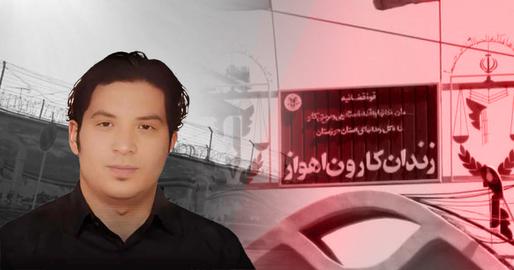
A week ago, Jaber Sakhravi, an Iranian Arab political prisoner incarcerated since 2014 without a single day of furlough, was taken to the hospital with stroke symptoms. He has since been sent back to prison.
Sakhravi is accused of membership in Harakat al-Nidal, or the Arab Struggle Movement for the Liberation of Ahvaz, and is serving a sentence of 12 years and 5 months.
A source close to Sakhravi told IranWire that he had Multiple Sclerosis (MS) before his arrest, which was under control.
However, the source says that due to severe torture during interrogation, Sakhravi's condition significantly worsened.
When he arrived at Karoun prison in Ahvaz ten years ago, "He was walking on all fours like a small child" and was unable to stand.
Questions remain about Sakhravi's current condition and the judiciary's case handling.
A week later he was moved to a hospital, and the human rights organization Karun confirmed that Sakhravi's condition was critical.
Medical tests showed he had suffered a stroke and, with a blood pressure reading above 170, required immediate and long-term treatment.
Despite his serious condition, Sakhravi was handcuffed to his bed, and his relatives were not allowed to visit him.
Karun expressed concern that he was discharged from Golestan Hospital without receiving proper medical care and was returned to prison.
According to his doctor's diagnosis, Sakhravi needed hospitalization and more than twenty physiotherapy sessions.
However, prison authorities ignored this advice and transferred him back to prison while he remained in critical condition.
Karun Human Rights Organization expressed "deep concern" over this "unfair action and indifference of the security authorities" and called for "immediate intervention to guarantee the human rights of this political prisoner and provide him with the necessary treatment."
Jaber Sakhravi, a computer engineer from the Alavi district of Ahvaz, was arrested on March 24, 2014, in Ahvaz.
He was transferred to the Ahvaz Intelligence Department detention center, one of Iran's most notorious security facilities.
Accused of being a member of the Harakat al-Nidal Movement, he was moved to Karun prison in Ahvaz about three months after his arrest.
A source in Karun prison told IranWire that despite having multiple sclerosis (MS), he was severely tortured in the Ahvaz Intelligence Detention Center.
"During his detention in the Ahvaz Intelligence Department, Jaber's MS worsened. When he was sent to Karun Prison, he was in very bad condition," the source said.
"He was unable to stand and was walking on all fours like a small child. His eyesight had also deteriorated."
The source emphasized that Sakhravi's MS was under control before his arrest, and he led a normal life.
Multiple sclerosis (MS) is an autoimmune disease where the body's immune system attacks nerve and spinal cord cells.
MS sufferers need regular treatment and care to prevent irreparable damage. Stress is known to significantly affect the progression of MS.
According to the Atlas of Prisons of Iran, a human rights organization, Sakhravi suffered a stroke even during temporary detention and interrogation in March 2014.
He was taken to the hospital with stroke symptoms but was returned to the Ahvaz Ministry of Intelligence detention center for further interrogation.
The report said that one side of his body was "paralyzed."
A source who spoke to IranWire, whose name is withheld for security reasons, said that Sakhravi has not had a single day off in the past 10 years.
Despite his illness and the need for treatment outside prison, he was only sent to the hospital a few days ago.
The source added that despite having MS and now a stroke, along with issues such as "swelling of the testicles" and "kidney and urinary tract pain," prison authorities and security officers oppose granting him leave.
The prison does not accept responsibility for providing his medications: "His family used to prepare his medicines, but the prison has repeatedly obstructed and prevented the delivery of the medicines."
According to this source, Sakhravi noticed at one point that the hospital was changing his medications, giving him sedatives or sleeping pills.
"This issue distressed him greatly, and after confronting the authorities, he was beaten several times despite his illness and mobility problems."
Including the days of solitary confinement, which Ali Khamenei, the leader of the Islamic Republic of Iran, recommended years ago and the parliament asked the judiciary after the protests of 2009 to count each day as equivalent to 10 days, Jaber has served his sentence.
However, despite suffering a stroke and losing the ability to speak clearly, he was sent back to prison.
An informed person close to Sakhravi told IranWire about his family situation: "His father is dead, and his mother is elderly. He has one brother and three sisters and is not married yet."
According to this source, Sakhravi's and his family's financial situation is dire, with his sister's husband providing support.
The source adds: "Jaber was unemployed before his arrest due to his MS. His physical condition did not allow him to work, despite having a good university education."
"Before his arrest, Jaber played the guitar. Even now, he loves music and, despite his illness and health problems, tries to lead his life through art and music."
Another source familiar with Sakhravi's case told IranWire that his nephew and uncle, Mehdi Khanipour and Mohammad Khanipour, were also accused in the case.
Mehdi was sentenced to 17 years in prison, but his uncle was released on bail after several months of detention and was later acquitted in the Ahvaz Revolutionary Court.

Interested in writing for IranWire?
Share your stories.



comments