



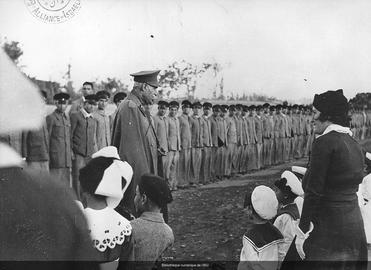
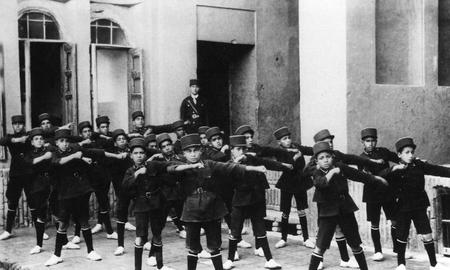
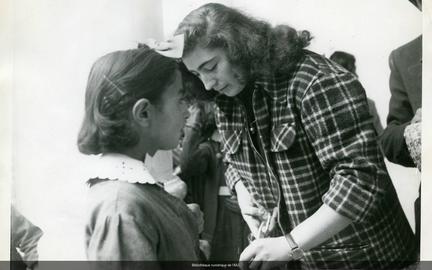
Shah Reza Pahlavi was in a terrible mood on the day in 1936 when he visited the Jewish school in Hamadan, because there was dust everywhere. Furthermore, to the Shah’s surprise, the little boys were dressed as sailors, and the director of the school, a young woman named Bathia Brasseur Cuenca, was visibly a foreigner. Yet she introduced herself to the Shah in perfect Persian.
A tense moment followed: no one knew how the Shah would react to a foreigner directing a school. Then the Shah’s son told him, “It’s the daughter of Brasseur of Isfahan,” citing the name of a well-known former school director who had established a kalamkar (silk textile) factory in that city. The Shah looked again at the children and, despite his mood, joked, “We have the sailors, but we don’t have the boats.” He left, and everyone else breathed a sigh of relief.
Why was the Shah of Iran visiting a Jewish school, and who was this young woman, a foreigner who spoke perfect Persian? The existence of these schools and the reason for the Shah’s visit have much to teach us about the history of Jews in Iran in the late nineteenth and early twentieth centuries and education in Iran under the Pahlavi regime.
Jews in Iran
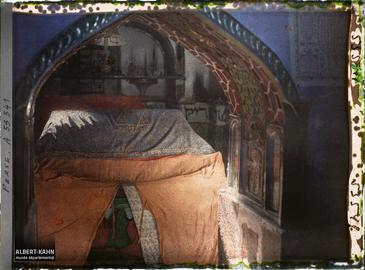
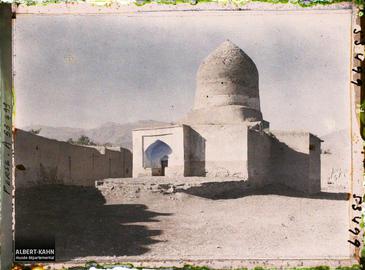
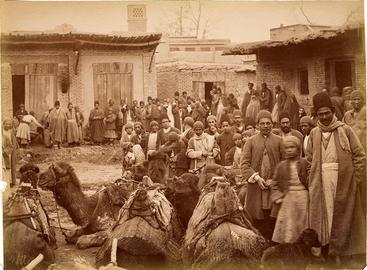
At the turn of the twentieth century, the number of Jews in Iran numbered only around 40,000—less than the population of Jews in the city of Baghdad alone. Compared to Jews in North Africa and the Ottoman Empire, Iranian Jews were overall poorer, smaller in number, and less connected through global trade networks. Yet Jews also had a long, deep and rich history in Iran. Jews have been a part of the fabric of Iranian society for the last 2,700 years. They had developed their own regional dialects, had a strong tradition of rabbinical scholarship, and had a mythological connection to Iran through the biblical story of Queen Esther and her uncle Mordechai, to whom there is a shrine in Hamadan.
Although many Jews relied on peddling for income, they also practiced carpet-weaving, spinning cotton and silk thread into thicker weft for European looms, stonecutting, and producing tragacanth gum, a plant-derived gum that can be used for pharmaceutical and industrial purposes. Iranian Jews were disproportionately likely to enter healing professions, such as midwives, pharmacists and doctors, and a few of the doctors to the Shahs had been Jews.
Jews did not have equal standing to Shia Muslims. They shared their status as ahl al-ketāb, or “people of the book,” with Zoroastrians and Christians and were thus assigned the status of dhimmis, who were both protected and inferior under Qur’anic law. Dhimmis were required to recognize the superiority of Islam, had to pay a special jizyeh tax, and were subject to unfavorable inheritance laws. Iranian Jews also endured occasional but devastating assaults, such as the forced mass conversion of the Jewish community of Mashhad in 1839 or a pogrom in Shiraz in 1910. These were usually instigated on a local level within the context of power struggles between Muslim clerics.
Jews tended to be less persecuted than Baha’is, who were not recognized as a religious community. However, they were also less well-connected than other minorities with ties to diaspora communities. Iranian Armenians, for example, had longstanding ties to Armenians in the Russian Caucasus and Anatolia (present-day Turkey). The educated elites from those regions, especially the women, organized charitable philanthropies, built schools, and addressed the basic needs of their brethren in Iran. Similarly, Zoroastrians in Iran were connected to wealthier Parsi communities in India, as did Iranian Baha'is to Baha’is in the United States. Through most of the nineteenth century, Iranian Jews had only sporadic contacts with European Jewish organizations. That would change in 1898, with the arrival of the Alliance Israélite Universelle (AIU).
The Alliance Israélite Universelle in Iran
The Alliance Israélite Universelle was a Paris-based Jewish international philanthropy that had established schools across the Middle East and North Africa. The AIU was established in 1860 by Western European Jews in the wake of shocking and widely publicized antisemitic incidents. In one, the “Mortara Affair,” a six-year-old Jewish boy was kidnapped by the Catholic Church in Bologna, Italy, under the pretense that he had been secretly baptized.
Even before that, in the 1830s-1850s, the AIU’s founders had traveled to Jewish communities in North Africa and the Ottoman Empire, and North Africa and developed a view of “Oriental” Jews as superstitious and oppressed. In the eyes of the European Jews, the North African Jews needed enlightenment, hygiene, and modernization.
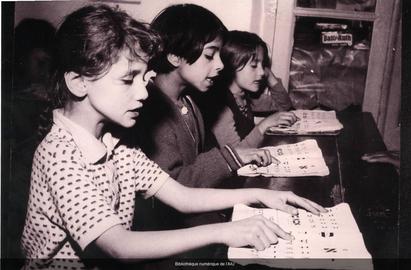
To accomplish those goals, AIU founders chose two strategies: diplomatic negotiation with local governments to end antisemitic attacks and a modern, secular education. Importantly, this included education for girls. In fact, schools like those of the AIU were among the drivers of girls’ education around the world, particularly in countries in the Middle East.
Equally importantly, the AIU did not encourage emigration to Palestine. Rather, it sought to emancipate and integrate Jews in the countries in which they lived.
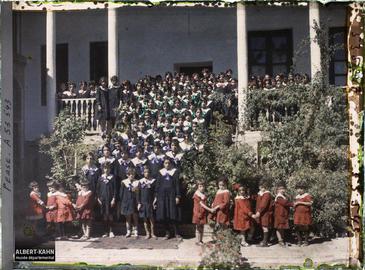
The first AIU school was established in Tetuan, Morocco, in 1862. It took another 38 years before the Qajar shahs allowed the first schools to be established in Iran. Once the AIU staff arrived, however, they worked quickly and established schools for over 2,500 boys and girls in six cities by 1904 and schools in six more cities by 1929.
The Alliance enjoyed exceptional longevity in Iran, operating schools up until the Iranian Revolution of 1979. Over the seventy years of its existence in the country, the AIU educated tens of thousands of girls and boys in over a dozen cities.
Most of its students were Jewish, but many were also Muslim and Baha’i. In fact, AIU schools tended to attract the children of prominent and wealthy Muslims, as they offered a very good education in French but without the proselytization of Christian schools. AIU schools actually offered classes in the Qur’an to its Muslim students. The schools also attracted those Muslims who were looking to educate their daughters.
The AIU and the Pahlavi Regime
Reza Khan took power in a coup in 1921 and crowned himself Shah in 1925. As part of his efforts to modernize Iran, his regime embarked on a series of educational reforms that were designed to reach more Iranian children and instill a strong sense of Iranian nationalism. The regime developed a new curriculum and began printing textbooks in 1928.
When it first set up schools in Iran, the AIU curriculum was primarily in French. However, in 1927, the Pahlavi regime designated the AIU schools as melli, a word that literally translates to “national” but in this case meant “semi-private.” This action brought the AIU schools under the control of the Ministry of Education. The AIU school system was now required to change its name to the Persian Ettehad, meaning “Alliance.” Unlike French Catholic schools, which were allowed to continue teaching primarily in French, AIU schools were mandated in 1928 to switch to Persian as the main language. This relegated French to the status of a foreign language. The government required AIU schools to follow the public-school curriculum but also began to provide resources in the form of teachers of state-mandated subjects.
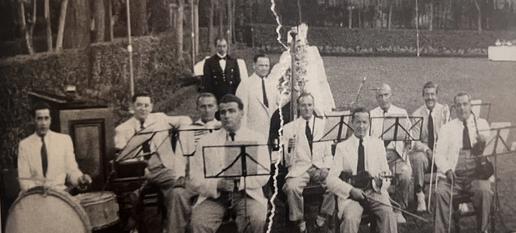
For the most part, the AIU’s leadership cooperated willingly with the state and went out of its way to showcase the schools to Iranian dignitaries, which is one reason why the Shah was visiting the AIU school in Hamadan in 1936.
The Brasseur-Cuenca Family
Bathia Brasseur Cuenca came to Iran in 1908 as a toddler with her parents, Adolphe and Séphora Brasseur. Adolphe was French-Jewish and raised in Beirut, and Séphora was Russian-Jewish and raised in Palestine. The two met at the AIU’s school in Palestine, married, and directed the AIU schools in Manisa, Turkey. In 1908, they moved to Isfahan to direct the AIU’s Isfahan school, bringing Bathia and her older brother.
Over the next seventy years, three generations of this family would work for the AIU in Iran. This included Bathia and her two sisters, Wanda and Louise, who taught in and directed schools in Yazd, Hamadan, Isfahan, Kermanshah, and Tehran. Bathia’s husband, André Cuenca, served as the General Director over all the AIU’s Iran schools from 1946 to 1978.
During World War II, the Germans devastated the AIU’s operations and central headquarters in Paris. Most of the members of the Central Committee fled the city, while others were arrested and imprisoned. Relatives of the Brasseurs who were in Europe fared badly. Some served in the French resistance while others were forced into hiding. Even more tragically, those who had remained in Greece were deported and murdered during the Holocaust, which killed ninety percent of Salonica’s Jewish population.
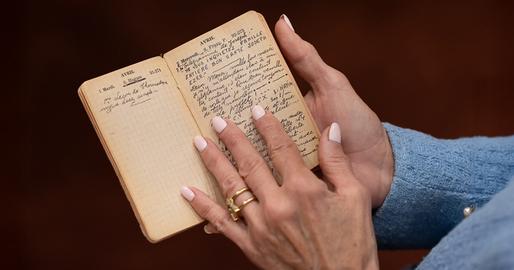
In Iran, the Brasseurs experienced relative safety but still turbulence and anxiety. Most AIU schools in Iran continued to operate, albeit on a shoestring budget. Bathia and her husband were coerced into providing intelligence for the British. Louise spent two years teaching in the Isfahan school and barely receiving any salary. After transferring to Tehran, she used her skills in English and typing to do side work for the British Embassy and the U.S. Army’s Office of Propaganda. From May to September of 1944, Louise worked as a writer and broadcaster for Radio Amsterdam’s station in Tehran before going back to teaching. Meanwhile, the sisters’ older brother, Léon, worked in New York in the France Libre consulate during the war where he was noticed by Charles de Gaulle.
In the decades after World War II, the AIU expanded its operations in Iran. Eventually, however, the schools became progressively under the control of the Pahlavi regime and lost much of their French character. Those Iranian Jews who reached the middle class, often chose to send their children to Iranian public schools or the Iraqi-Jewish Ettefagh school in Tehran. The AIU continued to serve poorer Jewish children and increasingly more Muslim children.
Tragically, both Wanda and Louise died young, but most of Bathia and Andre’s family remained in Tehran. Bathia died in 1974, and seven thousand people attended her memorial service. Two of Bathia and André’s daughters married into the prominent Elghanian family. Their relative Habib Elghanian, was summarily executed in May of 1979 on bogus charges of being a Zionist spy, despite his deep love for Iran.
Those events were still decades away when Reza Pahlavi visited the Hamadan school. A nine-year-old girl named Parvine Motamed presented him with flowers. She went on to become one of the first women in Iran to earn a graduate degree and eventually became the director of Iran’s ORT schools, another Jewish school network that educated poorer Iranian Jewish girls and boys. Parvine is but one example of the important role that AIU schools played in educating girls and integrating Jews into the larger Iranian society.
For more information and resources relating to the AIU, please visit https://www.bibliotheque-numerique-aiu.org/.

Interested in writing for IranWire?
Share your stories.




comments