



“The bell rang, announcing that the exam had started. Total silence descended on the hallways and chambers where the exam was taking place. All eyes were fixed on the envelope containing the test. After the papers were distributed, everyone’s heads bent down to read them, and a moment later a wave of anxiety, anguish and panic washed over some of the faces. Their flaming cheeks were windows into their anger, outrage and sorrow. The eyes of a group of students, most of whom appeared to be serious and hard-working, were tearful. When I asked why, I was told: ‘The last question was not in the textbook and we have not studied it.’”
This was part of the introduction to a critique of textbooks in Iran, written around 1963 by the Iranian woman Malekeh Taleghani, Deputy Education Minister, and who had years of experience as principal of Tehran’s Jam-e Jam school. Later in her life she would also become a member of Iran’s parliament.
Despite her long experience in education and politics, there is little information about Malekeh Taleghani, even in books on the Iranian women’s movement. Her memoir, written in the last years of her life, has not been published in Iran. Iranian readers cannot find it easily. But more can be found about Malekeh Taleghani and her views on education in articles she wrote throughout her career.
In her efforts to change the lives of Iranian women, Malekeh also succeeded in moving past a traditional religious upbringing and early marriage, studying long and hard, until she received her PhD.
Malekeh Sheikh Hojjat Taleghani was born in 1926 in an old house on Tehran’s Amirieh Avenue. She was the first child and the only daughter of Sheikh Mohammad Reza, a cleric, and prayer leader at one of the local mosques. He married several times, in addition to her mother, making Malekeh the elder sister of seven brothers.
Her mother was a selfless and enlightened woman: but she lived with a man who repeatedly married women to whom he was attracted but whom he would neglect or abandon once a first child was born. Malekeh’s mother did not divorce her husband but separated her home from his.
Malekeh was still an adolescent when her future husband, Abbas Karimi, asked her father for her hand in marriage. Since his childhood, this suitor had been her father’s muezzin, a person who calls people to daily prayers, and when he learned that Sheikh Mohammad Reza had only one daughter, he asked to marry her without having seen her. The two were not allowed to see each other until the marriage ceremonies were complete. Each saw the other for the first time that night. But as luck would have it, the young bridegroom, unlike Malekeh’s father, was an enlightened man and relatively educated.
Adolescent Bride Goes to School
The couple soon had two children. But Malekeh could not stop thinking that she wanted to get an education. Her husband saw this deep interest and encouraged her. In her memoirs, she writes that one day her husband came to her with a piece of bread and cheese and told her: “Ma’am! I can make do with this bread and cheese; I don’t want you to make me [full-course meals]. You just go and study.”
They went together to register her at Namus School, one of the first schools for girls in Iran. Married women were not accepted to day schools at the time, but the principal ignored this ban and registered her. It was a favor that changed Malekeh’s life. She eventually received her high school diploma from Tehran’s Shahdokht High School.
Malekeh Taleghani took her studies seriously and continued to study even after giving birth to two more children. She was interested in natural sciences and mathematics but, at the request of her husband, she chose to study literature in high school and received her master’s degree in literature.
Her husband then asked her to cease her studies. Malekeh accepted – even though it went against her wishes. One day, a classmate told her: “What a loss! Why don’t you continue your education?”
When Malekeh shared with her husband what she had been told, he gave his consent, and she registered at the university for her PhD. While studying for her degree in literature, she also taught Arabic at Tehran’s prestigious Anoushiravan Dadgar High School. One of her pupils was Princess Shahnaz Pahlavi, the daughter of Mohammad Reza Shah. She was a kind but strict teacher and tried to use modern methods of teaching rather than traditional ones.
In 1963, the same year that Iranian women gained the right to vote, Malekeh received her PhD in Persian literature. She continued to teach – a job she loved.
The same year, however, many suggested that she should have her own school. The family owned a large house in eastern Tehran, with a garden, and they decided to turn it into an educational institute offering everything from kindergarten to a dormitory. They named it Jam-e Jam Institute and it opened its door under the management of Malekeh Taleghani.
But she did not abandon teaching despite her new responsibilities. Malekeh started teaching at Tehran University’s School of Literature and Tehran’s Teachers College while also writing articles critiquing the country’s educational system and proposing advancements.
Malekeh took exception to the fact that students at different schools studied different textbooks, she said, while exams came from a single source. When “the Ministry of Culture [considered] the subject of textbooks, and their merits and faults were discussed, this author made statements in support of uniform textbooks … uniform textbooks have numerous scientific, financial, ethical and educational advantages,” she wrote, and “the best outcome of making textbooks uniform across the country is that chance and luck would play no role in final exams, in scientific and literary competitions and in university entrance exams.”
Her persistence paid off: the issue of nonuniform textbooks was taken up by the Education Ministry after it was separated from the Ministry of Culture.
Deputy Education Minister and Member of Parliament
Malekeh was also a member of the board of directors of the Parent-Teacher Society, which brought her to the attention of Farrokhru Parsa, Minister of Education, the first female cabinet minister in Iran, who appointed Malekeh as her deputy. (Dr. Parsa was executed by firing squad in 1980, after the 1979 Islamic Revolution, for allegedly "causing corruption and spreading prostitution," among other charges.)
In 1966, after a failed attempt to assassinate Mohammad Reza Shah Pahlavi, Malekeh was elected from Tehran to an assembly responsible for amending the constitution so that the queen, Farah Pahlavi, could be appointed as vicegerent in case the shah was incapacitated.
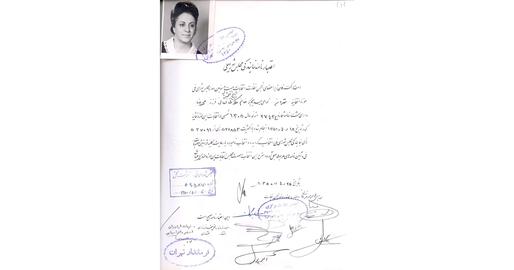
In 1971, Malekeh ran for a parliamentary seat in Tehran and was elected to the 23rd parliament with 522,853 votes out of 537,091 votes cast. In this parliament, she was a member of education, science and higher education committees.
In 1975, after four years in parliament, Malekeh returned to the Ministry of Education as its deputy for parliamentary affairs. Meanwhile, she continued to write on education and Persian literature. He also wrote two books: Women in Ancient Iran, coauthored with Farrokhru Parsa and Homa Ahi, and Morality and Society in Ferdowsi’s Book of Kings, referring to Iran’s epic national poem, written more than a millennium earlier.
Malekeh Taleghani left Iran for the United States after the 1979 revolution and settled in Portland, Oregon, with her husband Abbas Karimi and her children Simin, Soheila, Amir and Hamid. However, she continued to work on Iranian culture and also helped Iranian immigrants. According to a close friend, she managed to bring 40 Iranian refugees out of a refugee camp and provided them with opportunities to live a normal life in the community.
Malekeh Taleghani passed away on May 6, 2010, and was buried in Portland. She was seen off by her friends, her four children, her seven grandchildren and her nine great-grandchildren.

Interested in writing for IranWire?
Share your stories.



comments