



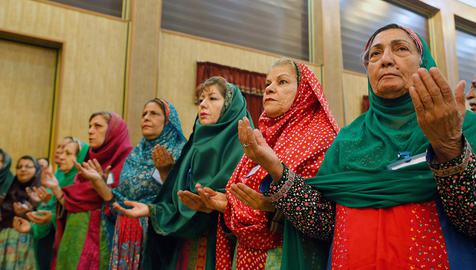
Quarterly Report: May-July 2025
Methodology Note: Iranian authorities impose severe restrictions on access to information and contact with victims of its repressive measures. Many Iranian activists, including those advocating for human rights, freedom of expression, and access to information, face harsh prison sentences for their work. Additionally, lawyers and others are routinely surveilled and threatened with similar consequences, affecting themselves and their families.
A System of Religious Monopoly
Religious minorities in Iran face systematic barriers to equal human rights due to a state structure that is built and maintained to preserve a religious monopoly. The preamble of the constitution of the Islamic Republic declares that “Islamic principles and norms” are foundational for the “advancement” of “institutions of Iranian society.” Article 12 further enshrines Twelver Ja’fari Shiism as the official state religion, and ambiguous “Islamic criteria” or “Islamic principles” govern all facets of life, from political participation to criminal law.
Religious minorities in Iran can be broadly divided into two main groups: those who enjoy official recognition and those who do not.
Officially Recognized Minorities and Conditional Freedoms Christians, Jews, and Zoroastrians enjoy limited freedoms in “rites and ceremonies,” “personal affairs,” and “religious education” “within the limits of the law” (Article 13). Some Sunni Muslim schools are also “accorded full respect” (Article 12). However, these rights come with significant restrictions. For instance, these groups are, in practice, further qualified (“Christians” include only those whose religious identity derives from their Assyrian, Chaldean, and Armenian heritages, and not converts from Islam to Christianity). Exercising their limited rights is conditional upon compliance with Islamic Republic restrictions and “red lines”.
Non-Recognized Minorities and Intensified Persecution
Minorities without official recognition, including Baha'is, Christian converts, Yarsans, atheists, and followers of new religious movements, face an even harsher reality. Members of these groups are at a high risk of arbitrary arrest and prosecution (often on trumped-up security charges). They also face asset appropriation, denial of education and employment opportunities, restriction on worship and religious observances, and, in some cases, even capital punishment on charges of apostasy.“Minority” status in Iran is not simply a matter of demographics but also the outcome of a long-standing process of marginalization. Religious minority status may also overlap with ethnic identity, as in the case of Baluchis and Kurds, whose populations, concentrated chiefly in Iran’s border provinces, are predominantly Sunni Muslim.
This report, covering developments in the human rights situation of religious minorities in Iran from the beginning of January through the end of March 2025, is based primarily on IranWire’s findings. The analysis relies on IranWire’s coverage of religious minorities in Iran, based on first-hand reports from members of these groups or by citizen journalists and verified by professional journalists, as well as secondary sources published by reliable human rights organizations.
Judicial Repression
Religious minorities frequently face judicial repression for peaceful activities. In a judicial system lacking institutional independence (especially in the Revolutionary Courts that try political and security cases), such defendants are often charged with vaguely defined security violations under the Islamic Penal Code.
Christian Converts
Mansour and Mahmoud Mardani, brothers who had converted to Christianity, were convicted of “propaganda against the Islamic Republic by way of promoting Christianity” by the Revolutionary Court in central Isfahan by April 1. The pair were sentenced to four years’ prison, financial fines, and suspension of social rights for five years, in addition to a two-year ban from Isfahan Province and the city of Fouladhsahr and internal exile to the Ardal region. They were arrested from a house church in December 2021.
On April 6, the lawyer of four Tehran-based Christian converts–Mehran Shamloui, Abbas Suri, and Narges Nasri–who had been arrested in connection with their organizing of a house church in the fall of 2024, announced that Branch 36 of the Tehran Appeals Court had upheld a Branch 26 of the Revolutionary Court’s verdict against them. Shamloui has been sentenced to ten years and eight months’ prison. Suri and Nasri were each sentenced to ten years’ prison, a 15-year suspension on social rights, and a 330 million toman fine on charge of “promotional activities contrary to Islamic jurisprudence” and an addition five years’ prison on charge of “membership in societies opposed to the country”; Nasri was given another year of incarceration for “propaganda against the regime.”
As of April 14, Christian convert Parvin Ghadiani had been held for three months at Kachoui Prison, Karaj with authorities failing to specify her legal fate. A source close to Ghadian said her arrest by security forces pertained to her evangelical activities.
Baha’is
On April 15, Branch 104 of the Criminal Court of Ghaemshahr tried and convicted Baha’i woman Mariam Zabihi, sentencing her to ten months in prison on charge of “educational activities contrary to and disruptive of Holy Islamic law.” One of the acts mentioned in the verdict was the proctoring of tests for the Bahai’s unofficial university program, which the community created after being banned from higher education.
On May 7, three Baha’is–Arshia Rouhani, Hamid Manzavi, and Arash Nabavi–commenced outstanding prison sentences for convictions of “propaganda in favor of groups opposed to the state,” “propaganda against the government,” and “membership in groups intending to disrupt national security” at Dastgerd Prison. Rouhani and Manzavi’s original sentence of five years, and Nabavi’s of ten, were all reduced to two years at appeal.
Sheyda Rouhani, Sheydeh Tavakoli, and Sheila Tavakoli, three Baha’i women, were arrested and taken to an undisclosed location on May 27. Arresting security agents also seized personal electronics, documents, and assets belonging to the women. Their location and the charges against them were unknown as of May 30.
During and following the Israel-Iran war, security forces raided the houses of dozens of Baha’is, including 15 residences in Isfahan’s Baharistan area and four in Ghaemshar. Raids were also reported in other cities in Isafahan Province, Shiraz, rural areas of Buyer-Ahmad, and the Tangestan area of Bushehr. Agents seized religious publications as well and electronic devices, and arrested Baha’is Navid Tashakor, Arman Nik Ayin, and Iman Rahmatpanah.
Jews
By June 26, following the Israel-Iran war, at least 20 Jews had been arrested in Tehran and Isfahan, while security agents had raided the houses and seized personal belongings of another eight Jews in Isfahan and Shiraz. Two Jewish religious leaders in Tehran and Shiraz were summoned and pressured by security authorities, as were a number of liturgists.
Sunni Kurds
On April 23, authorities detained Sunni Kurdish cleric Ayat Gholami, a former mosque Imam in Kermanshah Province after summoning him to the Special Court for Clerics. Gholami was reportedly banned from mosque leadership activities in July 2024. In a video statement, he said security agents had demanded that he organize mosque activities only under their supervision.
Early in the morning of May 28, Revolutionary Guards intelligence agents arrested four Kurdish activists—Hiwa Ahmadi, Mohammad Zabihi, Soran Soltani, and Rahim Ghodrat—from their homes in Saqqez. Agents reportedly failed to produce warrants and used excessive force in the arrest.
Against the backdrop of the Israel-Iran war in mid-June, security agents arrested at least nine Sunni Kurds in Mahabad before taking them to undisclosed locations. Those whose names are known comprise Pouya Nasiri, Soroush Yousefzadeh, Omid Rehsh, Shahouh Mahmoudi, Souran Safari, Keyvan Mamehgoli, Asad Rasoulzadeh, and Nouraddin Dudkanalou Milan. At least four of the men were arrested in house raids. Nasiri, a law student, was arrested by plainclothes agents in the street.
Sunni Baluchs
On May 19, plainclothes intelligence agents arrested 17-year-old Baluch Rezwan Taraz in the Rask district of Sistan and Baluchistan Province. Agents halted him while he was riding a motorbike before detaining him. Intelligence officials did not respond to the family’s efforts to secure information about his whereabouts and legal fate.
On June 28, agents arrested five young Baluch men returning from the hajj pilgrimage at the Pang checkpoint in Jazmourian, Kerman Province: Shahram Bamari, Daniel Heydarzehi, Mehran Bamari, Peyman Bamari, and Mohammad Heydarzehi. Their whereabouts and charges against them were not communicated by authorities.
Due Process Failures
Religious minorities in Iran continue to suffer from systemic due process failures that undermine their rights in legal proceedings.
Christian Converts
Christian converts Mehdi Rahimi and Kia Rouhinia were convicted by Branch Three of the Revolutionary Court of Tabriz (Judge Hassan Fathnejad presiding) on May 23, receiving a sentence of ten years’ prison for “promoting perverse Christian Zionist beliefs” and two years’ prison for “transporting prohibited goods (i.e. religious texts),” in addition to a fifteen-year ban on social-legal activities and a fine amounting to one billion tomans plus ten times the value of religious texts they were found to have transported. Rahimi and Rohinia were not presented at their trial and the court failed to obtain defense statements from them.
Bahai’s
On May 2, Baha’i citizen Hoshidar Zare’i was arbitrarily compelled to serve an incarceration sentence at Adelabad Prison for “promotion of a cult to the benefit of anti-regime groups” after his original sentence, five years of controlled movement with an electronic ankle bracelet (within a thousand meters of his house), was overturned for unclear reasons. He had started serving his electronic monitoring sentence in October of 2023.
On May 13, three Baha’i women from Rafsanjan—Elna Na’imi, Bashari Mostavafi, and Didar Ahmadi–were sentenced to four months’ prison by Branch Seven of the Appeals Court of Kerman Province for charges of “promotion to the benefit of groups and organizations opposed to the Islamic Republic regime.” In a highly arbitrary development, the three were convicted after a lower court had acquitted them of the same charges by reason of insufficient evidence. The Rafsanjan Prosecutor’s Office protested and pursued the case nonetheless.
By late June, 26 Baha’i defendants from Shiraz faced renewed prosecution despite a final acquittal pursuant to a Supreme Court decision. First arrested in the summer of 2016 in connection with acts including environmental activism, they were not tried and sentenced until the spring of 2022, when Branch One of the Revolutionary Court of Shiraz found them guilty of “assembly and collusion for the purpose of disrupting domestic and external national security” and sentenced them to prison terms, internal exile, and a ban on exiting the country. Appeal to Branch 37 of the Appeals Court of Fars Province resulted in a sentence reduction. Branch Nine of the Supreme Court, reviewing the case, found that membership in the Baha’i organization alone was not sufficient to substantiate the charge, and referred the case to Branch One of the Appeals Court of Fars Province, which acquitted the defendants in a final verdict on January 14, 2023. Nonetheless, Fars Province Attorney General Seyed Kazem Mousavi, at the request of Revolutionary Court Judge Seyed Mahmoud Sadati (who had reportedly expressed dismay at being overruled by superior judges in Tehran), moved to have the case re-opened in May 2024. The 26 defendants were thus summoned to Branch Two of the Appeals Court of Fars Province on June 30.
Prisoners’ Rights
Independently of failures of due process which may lead to wrongful detentions and convictions, those incarcerated in Iran may be denied fundamental rights as prisoners. Members of religious minorities, lacking the resources and influence to advocate for themselves, may be especially vulnerable to such abuses.
Sunni Kurds
In early May, Kurdish political prisoner Khaled Zamani continued to be denied a furlough after serving 17 years in Yazd Central Prison. The prison’s Classification Council and Yazd Prosecutor had reportedly agreed to grant the leave, but the Revolutionary Guards Intelligence Organization intervened to prevent it. Arrested in 2004, Zamani was originally sentenced to by the Orumieh Revolutionary Court to hand and foot amputation on charge of "waging war against God" by way of membership in the Free Life Party of Kurdistan; this sentence was eventually changed to 30 years’ prison.
The Right to Life
Iran remains one of the world’s most active execution states, with one of the highest per capita death penalty rates. Religious minorities remain at disproportionate risk of capital punishment in the country. For instance, data from Iran Human Rights indicated that of the at least 975 executions conducted by the Islamic Republic in the year 2024 alone, 11% of those put to death were (predominantly Sunni) Baluchis, despite their ethnic group comprising only two to six percent of Iran’s population. In cases involving the death penalty, due process violations are even more concerning.
Sunni Baluchs
On May 4, seven people including Baluchs Khosrow Sarani (41), Mahmoud Sarani (aka Rakhshani, 41), Yousef Sorourvash (52), and Alireza Lalouzai (52) were put to death on drug charges at Birjand Central Prison, South Khorasan Province.
Sunni Kurds
By June 4, Iran’s Supreme Court upheld the capital sentence of 32-year-old Azad Shojaei, convicted of involvement in the 2020 assassination of nuclear scientist Mohsen Fakhrizadeh. The Revolutionary Court in Orumieh found Shojaei, a border courier, guilty of espionage on behalf of Israel and transporting equipment used in the killing. Shojaei was convicted in part on the basis of a reportedly coerced confession extracted in the course of an eight-month incommunicado detention. On June 23, the day after the Israel-Iran ceasefire took effect, Azad Shojaei was put to death at Orumieh prison, along with two other defendants in the case, Edris Ali (also a border courier) and Rasoul Ahmad Rasoul.
On June 25, law enforcement officers fatally shot 34-year-old Sunni Kurd Azad Ra’nai in Sanandaj. Officers reportedly stopped Ra’nai on his motorcycle and moved to search it, leading to an argument.
Economic and Social Rights
When it comes to social and economic rights, Iran’s legal framework, paired with a history in which Shia Islam has been privileged over other currents, has produced striking inequalities along religious lines, which often intersect with ethnic identity. The state may also act directly, through judicial or other means, to strip minority members of property and livelihood.
Baha’is
On April 3, the businesses of four Baha’i citizens of Orumieh were forcibly shut down after their owners had closed them in observance of unauthorized Bahai’ religious occasions. 20 Baha’i businesspeople in Shiraz were reportedly summoned and faced charges of “propaganda against the regime” for the same reason.
Sunni Kurds
Facing economic marginalization, minority groups in border provinces often turn to precarious informal work transporting goods across borders, where they are at increased risk of physical injury and violence by state agents.
On April 27, border guards in the Hangazhal area opened fire without warning on border couriers Ako Sharifi (22) and Shwane Alipour (25). Both were taken to a hospital with severe injuries.
Freedom of Assembly and Expression
Following Israel’s attack on Iran, Iranian security authorities pressured the country’s official Jewish organization to send electronic messages to Jewish citizens which warned that contact with Jews outside the country was forbidden and that they would be held responsible for statements or social media material they circulated regarding the war. Another message requested that Jews participate in a June 25 gathering to show support for Supreme Leader Khamenei held at Tehran’s Abrishami Synagogue; the Jewish representative to parliament was in attendance.
Interested in writing for IranWire?
Share your stories.


comments